NHL Realignment Project – Week 37


NHL Realignment Project - Week 37

West, west, west, west, east

This week we’re adding four new teams to the map west of the Gretzky-Orr line (two via expansion and two via relocation). Just to make sure the eastern side of the map doesn’t feel completely neglected we’ve allowed another relocation to stay within the Orr Conference. The Pacific Northwest has a love of hockey that is untapped and the MLS is showing us that the Vancouver/Seattle/Portland corridor has great fans that love great rivalries with their “neighbors”. Houston and KC round out the central part of our map and Quebec gets the team they deserve. I also threw Columbus a bone, and let them keep their team this week. Let’s check it out.


The Map:

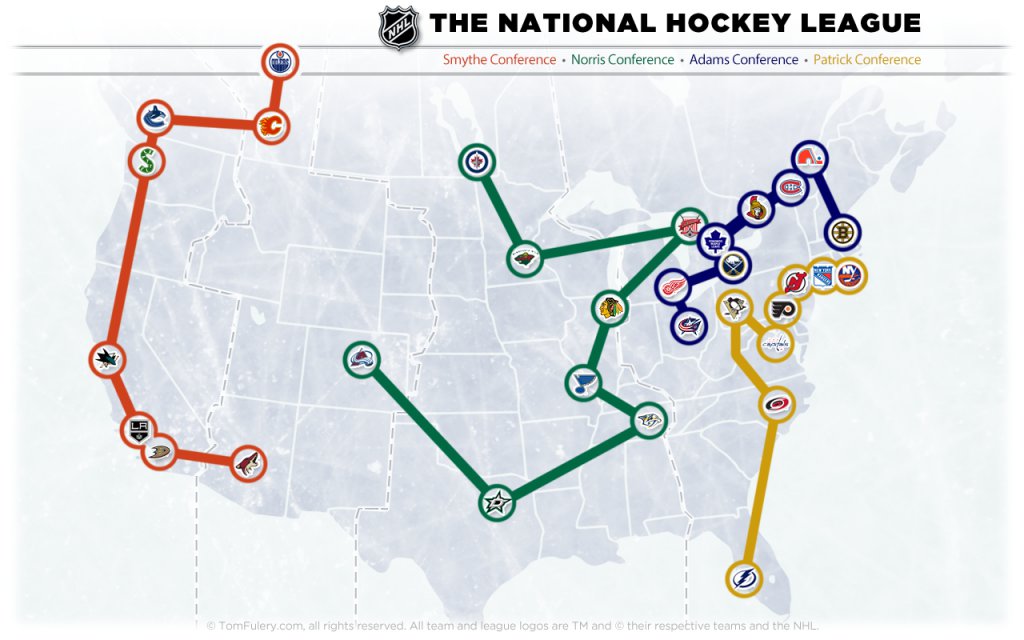
NHL Realignment Map - Week 37

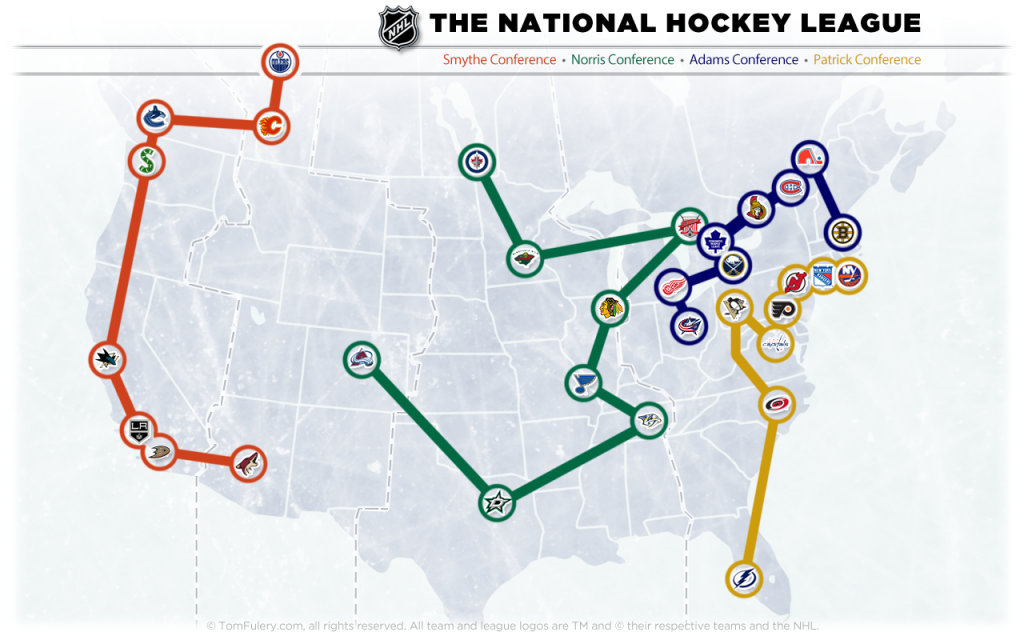
NHL Realignment Map - Week 37


The Breakdown:

We’re going with a 2 conferences of 2 divisions each format. Again, we’ve named the conferences are  for Gretzky and Orr while the division names are our old favorites—Patrick, Adams, Norris, and Smythe. Eight teams in each division giving us a total of 32 teams.

The Wayne Douglas Gretzky Conference
Smythe Division Norris Division
Anaheim Ducks Chicago Blackhawks
Calgary Flames Colorado Avalanche
Edmonton Oilers Dallas Stars
Los Angeles Kings Houston Aeros
Portland Eagles Kansas City Scouts
San Jose Sharks Minnesota Wild
Seattle Totems St. Louis Blues
Vancouver Canucks Winnipeg Jets
The Robert Gordon Orr Conference
Patrick Division Adams Division
Buffalo Sabres Boston Bruins
Columbus Blue Jackets Carolina Hurricanes
Detroit Red Wings Montreal Canadiens
Nashville Predators New Jersey Devils
Philadelphia Flyers New York Rangers
Pittsburgh Penguins Ottawa Senators
Tampa Bay Lightning Quebec Nordiques
Toronto Maple Leafs Washington Capitals

Gained Teams:

Seattle, Portland, Kansas City, Houston, Quebec City


Lost Teams:

Miami, Long Island, Phoenix


The Benefits:

• Geography — Like last week, every team has to travel to Canada for divisional games. Every division is stretched vertically (the two easternmost a little less, but still very stretchy), so that is reasonably equal as well. All this means that nobody can whine about “Our travel leaves us at a massive disadvantage”.

• Travel — Once again, North-South is the way. Divisional games may necessitate long trips, but again, staying within your time zone or only having to travel one over makes all the difference for player fatigue and for TV ratings.

• Rivalries —  Though we lose CHI/DET, we do get TOR/DET… not bad. The NYR/NJD, the Alberta teams, Pennsylvania teams, and BOS/MTL all stay together too, so check that off your list. New teams give us great rivalries too, SEA/POR/VAN, DAL/HOU, KC/STL

• Heritage —  C’mon! The division names are awesome. Hockey is special, now the conference and division names reflect that.


Scheduling:

Divisional Games: 3 home & 3 away vs. 7 teams = 42 games

Non-Divisional Games: 1 home & 1 away vs. 24 teams = 48 games

TOTAL = 90 games—yay, more hockey.


Playoffs:

Top three from each division qualify, plus next two best records from the conference (as wildcards).

Division Champs seeded 1 & 2, based on record. All other qualifiers seeded 3-8, based on record (so yes, a wildcard can have a higher seed than a top-three qualifier. This keeps the regular season more interesting and division-focused, as finishing top-three is the first ticket into the playoffs. Wildcard is just a backdoor option to keep things a little fair for 4th and 5th placed teams in a division who is having “a super-stacked-with-awesomeness year”.

Once qualification happens (division-centric), other than division champions getting 1 & 2, it’s all about your record for seeding (conference-centric). This way we are more likely to avoid a “two-best-teams-meeting-too-early-in-the-playoffs scenario”.

(H/T to oilersnation.com for the original map)


Don’t forget to share our lil’ project with your hockey fan friends. And, as always, thanks for reading. Until next Sunday!

— TF

Make sure to check out the entire NHL Realignment Project ».


NHL Realignment Project – Week 36

NHL Realignment Project - Week 36

Getting Vertical, Eh!

Only a day late this week! Getting better.

So this week we’re not quite as farcical as in the past few weeks, but haven’t completely re-entered the world of “reality-based” realignment either. This week’s theme is all about going Canadian. By relocating some teams and re-jiggering the divisional alignments, we’ve been able to get at least one Canadian team in each division. Let’s have a look at how this plays out.


The Map (Complete with goofball division names based on landmarks found at the border):

NHL Realignment Map - Week 36
NHL Realignment Map – Week 36

The Breakdown:

We’re going with the current 2 conferences of 3 divisions each format. The conferences are named for Gretzky and Orr while the division names are a little more fun—they are named for landmarks found at the borders, more-or-less where one might cross to visit the Canadian team(s) in your division… well, if the boys weren’t crossing tens-of-thousands of feet overhead in first-class luxury. This includes border straddling bridges, airports, monuments, etc. Obviously this would never fly, but whatever. Its fun.

The Wayne Douglas Gretzky Conference
Peace Arch Chief Mountain Piney Pinecreek
Anaheim Ducks Calgary Flames Chicago Blackhawks
Los Angeles Kings Colorado Avalanche Dallas Stars
San Jose Sharks Edmonton Oilers Minnesota Wild
Seattle Metropolitans Las Vegas Scorpions St. Louis Blues
Vancouver Canucks Utah Coyotes Winnipeg Jets
The Robert Gordon Orr Conference
Ambassador Thousand Islands Blackpool
Detroit Red Wings Buffalo Sabres Boston Bruins
Florida Panthers Carolina Hurricanes Montreal Canadiens
Nashville Predators Ottawa Senators New Jersey Devils
Tampa Bay Lightning Pittsburgh Penguins New York Rangers
Toronto Maple Leafs Philadelphia Flyers Washington Capitals

Gained Teams:

Seattle, Salt Lake City, Las Vegas


Lost Teams:

Phoenix, Long Island, Columbus


The Benefits:

• Equality — Every team has to travel to Canada for divisional games (Las Vegas, Colorado and Utah need to do it a little more often… but I wasn’t about to break up the Alberta rivalry). Every division is stretched vertically (the two easternmost a little less, but still somewhat stretchy), so that is reasonably equal as well. All this means that nobody can whine about “Our travel leaves us as a massive disadvantage”. Even previously all alone Colorado gets a fairly near neighbor in the new Salt Lake City franchise.

• Travel — North-South is the way. Divisional games may necessitate long trips, but again, staying within one time-zone makes all the difference for player fatigue and for TV ratings.

• Rivalries —  Though we lose CHI/DET, we do get TOR/DET… not bad. The NYR/NJD, the Alberta teams, Pennsylvania teams, and BOS/MTL all stay together too, so check that off your list. All apologies to fans who live for the BUF/TOR games, but somebody has to sacrifice for the good of the league, right?


Scheduling:

Divisional Games: 3 home & 3 away vs. 4 teams = 24 games

Non-Divisional Games: 1 home & 1 away vs. 25 teams = 50 games

One additional home-and-away series against a conference opponent from each of the two divisions not your own (a five-year cycle that rotates through the conference) = 4 games

TOTAL = 78 games (bonus: we get to the playoffs quicker)


Playoffs:

Same as current format.

(H/T to oilersnation.com for the original map)


Don’t forget to share our lil’ project with your hockey fan friends. And, as always, thanks for reading. Until next Sunday!

— TF

Make sure to check out the entire NHL Realignment Project ».


NHL Realignment Project – Week 35

NHL Realignment Project - Week 35

Merge and Move

This week, we’re harkening back to a year in NHL history where it wasn’t about expansion and relocation, but something else… a merger. In 1976 the Cleveland Barons merged with the Minnesota North Stars, so we’re running with that precedence and doing a little house cleaning. In a cold, calculated move (based purely on numbers), we’re taking the four teams with the worst attendance this year and merging them into two new teams AND to make it even more fun, we’re moving the two resultant teams to two cities that lost their teams. OBVIOUSLY this never would happen, but I’m still in a farcical mood, avoiding reality-based realignment scenarios at least for another week. Let’s check out the fun…


The Map:

NHL Realignment Map - Week 35

NHL Realignment Map - Week 35


The Breakdown:

I’m actually gonna go back to the short-lived four-conference setup.

Pacific Conference Central Conference Northeast Conference Atlantic Conference
1. Anaheim Ducks 1. Chicago Blackhawks 1. Boston Bruins 1. Carolina Hurricanes
2. Calgary Flames 2. Detroit Red Wings 2. Buffalo Sabres 2. Florida Panthers
3. Colorado Avalanche 3. Kansas City Scouts 3. Montreal Canadiens 3. Hartford Whalers
4. Edmonton Oilers 4. Minnesota Wild 4. Ottawa Senators 4. New Jersey Devils
5. Los Angeles Kings 5. Nashville Predators 5. Philadelphia Flyers 5. New York Rangers
6. San Jose Sharks 6. St. Louis Blues 6. Pittsburgh Penguins 6. Tampa Bay Lightning
7. Vancouver Canucks 7. Winnipeg Jets 7. Toronto Maple Leafs 7. Washington Capitals


Gained teams:

Kansas City, Hartford


Lost teams:

Phoenix, Dallas, New York Islanders, Columbus


The Benefits:

• Travel — No team has conference-mates more than a single time zone over. And while the Pacific and Atlantic Conferences have pretty big north-south trips as part of their make-up, anyone who has traveled understands that that is much less taxing than east-west travel.

• TV Times — Kind of an added bonus from the previous entry, the lack of time zone insanity, keeps start times for most games within reasonable hours. Meaning better ratings and better exposure to/for young fans

• REVENGE — The folks in Hartford and Kansas City can do some happy-flips for getting their teams back. It worked for Winnipeg, right?

• Rivalries —  CHI/DET get to stay together. NY/NJ, PIT/PHI, EDM/CGY too. And KC/STL is reborn! Sorry we couldn’t get Hartford together with Boston, but they do get to jostle with their other traditional rival, NYR.

• Equity —  The conferences are all the same size… seven teams, so no whining.


(H/T to oilersnation.com for the original map)


Don’t forget to share our lil’ project with your hockey fan friends. And, as always, thanks for reading. Until next Sunday!

— TF

Make sure to check out the entire NHL Realignment Project ».

NHL Realignment Project – Week 33

NHL Realignment Project - Week 33

All the People, All the Time 

Okay, our short-lived happiness (or hatred for many others) of having finally gotten a bold new NHL that accentuates rivalries tries something new and isn’t just and NBA-on-ice is over and done with. Yes, we understand a good chunk of the purpose behind the plan in the first place was to act as a veiled first salvo against the NHLPA in the forthcoming CBA renegotiation… and begrudgingly I have to admit that it was a pretty brilliant calculation by the billionaires getting them the ever-elusive “win-win situation” against the millionaires. But whatever the reasons/ploys/shenanigans (for both the proposal and rejection) NHL realignment is where it is now… a necessary ingredient for future NHL success that is in more treacherous waters than ever AND now with tons of declared “issues” that one side or the other doesn’t want to have included.

So where do we go from here?

My seething anger at the snafu in general, and more specifically, the dark CBA implications that it foreshadows has died down a bit in the last 24 hours and  I’m ready to continue with the NHLRP. This week I’m gonna root my efforts in reality and do my very best to please all the people (we’re supposedly able to do this some of the time, no?).

I’ve cut out the BS, and sold the Phoenix franchise to suitors from Quebec City. The NHL (the league office, that is) is no longer in the business of running teams. If you’re an owner and want out, you find a buyer and you sell. If you can’t, your team is auctioned, and if necessary moved to a new city… and we do the re-alignment dance again.

The basis of this week’s map is this: there are TWO CONFERENCES made up of FIVE DIVISIONS each. Your principal job as a team in the new NHL is to win your division… basically, have a better record than the other two teams in your division and you’re in to the playoffs. The in-division hatred and rivalry will be amped up beyond belief with 8 games versus each of your two division-mates each season. To satisfy the “But wait, I’m in a stronger conference—boo-hoo” camp, if you don’t win your division, there are three wild-card spots in each conference available to sneak in you into the playoffs too. More on all this later. First let’s look at the map.


The Map:

NHL Realignment Map - Week 33

NHL Realignment Map - Week 33


The Breakdown:

Again, we have two conferences, named after (arguably) the best defenseman and the best forward of all time, Bobby Orr and Wayne Gretzky. In something more akin to the pod structure we’ve featured in a few past NHLRP entires, the conferences are divided into very small divisions of three teams each. In addition to being all equal in size (addressing one of the grumblings of the NHLPA and others in the now-dead plan), these smaller conferences lend themselves to a much better scheduling/travel structure as we’ll see in a bit as well (addressing an issue both sides have sited). Here is how the teams fit into the divisions. I tried my best to keep geographic and traditional rivals together (this one is mostly for the fans).

The Wayne Gretzky Conference The Bobby Orr Conference
Northwest Northeast
Calgary Flames Boston Bruins
Edmonton Oilers Montreal Canadiens
Vancouver Canucks Quebec Nordiques
   
Central North
Colorado Avalanche Buffalo Sabres
Minnesota Wild Ottawa Senators
Winnipeg Jets Toronto Maple Leafs
   
Heartland Empire
Chicago Blackhawks New Jersey Devils
Columbus Blue Jackets New York Islanders
Detroit Red Wings New York Rangers
   
Pacific Mid-Atlantic
Anaheim Ducks Philadelphia Flyers
Los Angeles Kings Pittsburgh Penguins
San Jose Sharks Washington Capitals
   
South Southeast
Dallas Stars Carolina Hurricanes
Nashville Predators Florida Panthers
St. Louis Blues Tampa Bay Lightning
   

Gained teams:

Quebec City


Lost teams:

Phoenix


The Benefits:

• Scheduling/Travel — Listen up, NHL and PA (and you to Red Wings and Stars)! Here is the solution the biggest issue of the day (besides the egos of many of the combatants in the forthcoming CBA battle):

3-team divisions mean that the season is made up of 3 things:

  • Divisional Play:
    • Home-and-home series against divisional opponents
  • Play outside of your Division:
    • 3-game road trips (each trip is against all three teams in a single division)
    • 3-game home-stands (same thing as above except at home)
- It’s simple enough for fans, players and owners to grasp.
- Road trips are reasonably short, and as an added bonus, the travel from game-to-game during each a road trip isn’t too bad since divisions are “reasonably small” in geographic scope.
- Everyone loves home-and-home series which mean to 120+ minutes of game-time agains “those same bastards” in a very few days (PIMs galore!). Toss in the fact that “those bastards” are who you are in essence, fighting against for a spot in the playoffs, and you play each of your two division-mates eight times(!) per season, those games will be more intense then we can imagine.
- Oh, and every team plays every other team both home and away (Something the NHL and the fans wanted). See the Schedule Breakdown section a little further down the page for even more on the sublime simplicity (and “you can’t argue against this-ness”) of the plan. By the way, if you need someone to write a program that will whip out a sample schedule (another of the NHLPA’s beefs, I know a guy… just send us a slice of your millions and billions and consider it done.

• Fairness — Unlike the  NHLPA, I don’t subscribe to the “the teams in the 7-team conferences have are more likely to make the playoffs” argument (listen, you are more likely to qualify for the post-season in an awful 8-team conference than a really competitive 7-team conference), but this point is moot now anyways. This new plan calls for all teams play in equal-sized divisions with the same coin-flip percentage of making the playoffs, so everyone is happy, right? Additionally, with the “escape hatch” of there being three wild-card spots available to the non-division champs with the three best records, and there should be no whining.

• Rivalries —  The majority of the principal divisional rivalries are preserved. PIT/PHI, the 3 NYC-area teams, DET/CHI, MTL/BOS, the 3 California teams, the 3 Western Canada teams are all keep alive and well.

• Homage/Heritage — We get to name the two Conferences after two great players who I hear are great guys as well. (Plus with 10 divisions mostly having directional names, I wasn’t about to throw two more directional names into the mix)

• John Williams — With a division named “Empire”, there definately be a lot of in-arena playing of Vader’s theme from Star Wars. Bahn-bahn-bahn, bahn-BA-duh, bahn-BA-dah!!


Scheduling:

Each team plays all it’s non-divisional opponents once at home and once on the road: 2 games x 27 teams = 54 games (played in three-game road trips to a single division, and three-game home-stands against a single division)

Each team plays it’s in-division opponents four times at home and four times on the road: 8 games x 2 teams = 16 games (played in home-and-home series)

Each team plays another set of games against a two divisions from the their same conference: 2 games x 6 teams = 12 games (again, played in a three-game road trip and three-game home-stand (which divisions you play rotates each year, complete in 2-year cycles)


54 games + 16 games + 12 games = 82 games

Pretty simple. It doesn’t completely keep Detroit and Columbus from having to make long in-conference road trips, but the trips are shorter in duration and more logistically sensible. Plus, as far as non-Eastern Time Zone road-trips go, the Wings and Jackets would only have two more of those than they would have Eastern Time Zone road-trips. The Stars, Ducks, Kings and Sharks no longer have to deal with a divisional opponent two time zones away either. Two MAJOR scheduling issues resolved! If they gave out Nobel Prizes for this kind of work… I’d like your support during the process, everyone. If a Nobel Prize is outta the question, I’d settle for life-time tickets to the Stanley Cup finals……….. or some backlinks.


Playoffs:

Playoff qualification is now a reward for hard-earned divisional championships with three wildcards available for the “fell-just short” teams. While this is a bit different, the structure of the playoffs themselves is pretty much what we currently have (addressing yet another major concern of many players, teams, fans).

• 5 division winners from each conference qualify for the playoffs (seeded #1-#5 by record)

• 3 best records amongst the non-division winners in each conference are awarded wild-card spots (seeded #6-#8 by record)

• Round One: Conference Quarterfinals — #1 vs #8, #2 vs #7, #3 vs #6, #4 vs #5

• Round Two: Conference Semifinals — Highest seed vs lowest seed, 2nd highest vs 2nd lowest

• Round Three: Conference Finals

• Round Four: Stanley Cup Finals

• All series best-of-seven (2-2-1-1-1 format, with highest seeded team (not necessarily best record) with home-ice advantage)


The Closing Argument:

NHL is just better when divisions mean more than conferences. Ladies and gentlemen of the jury, I present to you exhibit A in this argument: The NFL… and exhibit B: The NBA. It makes infinitely more sense for teams to identify with their own division and rally against division-mates in epic struggles to qualify for the playoffs, than to think of them as just another few teams to deal with in a vague quest against 14 other teams for one of 8 spots.

In short, we’d rather have teams claw, scratch and fight for 5 division crowns (with 3 consolation prizes), than meander through a season in search of one of 8 prizes (3 of which have a lil’ bonus attached).

“LAYWERED!”

*Drops Mic*


(H/T to oilersnation.com for the original map)


Don’t forget to share our lil’ project with your hockey fan friends. And, as always, thanks for reading. Until next Sunday!

— TF

Make sure to check out the entire NHL Realignment Project ».


NHL Realignment Project – Week 31

NHL Realignment Project - Wk31

Seeking 32 (Quebec City, Seattle, Houston)

First of all, sorry for the very late post this week… Christmas and its aftermath have been a beatdown. But better late than never, eh? This week we take our “Seeking 32″ idea and mess with it a bit. We do get to 32 teams in 4 conferences, but we through a tiny bit of a wrinkle in things by further dividing each conference into 2 pods of 4 teams each… now, before everyone freaks out, it is FOR SCHEDULING REASONS ONLY! Come back down off the ledges please, everyone… we’re not even gonna name them. Playoff format is still the same (top four in each conference qualify, but now you intensify the rivalries with your traditional and/or closest rivals and the schedule is a little more sensible.


The Map:

NHL Realignment Map - Week 31

NHL Realignment Map - Week 31


The Breakdown:

Again, our conferences all have eight teams… but (only for scheduling reasons), each is made up of 2 pods of four teams. Conferences are named for the four cardinal directions: West, South, East, North.

NHL West NHL South NHL East NHL North
1. Anaheim Ducks 1. Dallas Stars 1. New Jersey Devils 1. Chicago Blackhawks
2. Colorado Avalanche 2. Houston Aeros 2. New York Rangers 2. Detroit Red Wings
3. Los Angeles Kings 3. Nashville Predators 3. Philadelphia Flyers 3. Minnesota Wild
4. San Jose Sharks 4. St. Louis Blues 4. Pittsburgh Penguins 4. Winnipeg Jets
5. Calgary Flames 5. Carolina Hurricanes 5. Boston Bruins 5. Buffalo Sabres
6. Edmonton Oilers 6. Florida Panthers 6. Montreal Canadiens 6. Columbus Blue Jackets
7. Seattle Metropolitans 7. Tampa Bay Lightning 7. New York Islanders 7. Ottawa Senators
8. Vancouver Canucks 8. Washington Capitals 8. Quebec Nordiques 8. Toronto Maple Leafs


Gained teams:

Quebec City, Houston, Seattle


Lost teams:

Phoenix


The Benefits:

• Scheduling — We’ve finally cracked the code for scheduling… the scheduling pods made all the difference. See the “scheduling” section a little below for the deets.

• Fairness — While I, myself don’t subscribe to the “the teams in the 7-team conferences have are more likely to make the playoffs” argument (listen, you are more likely to qualify for the post-season in an awful 8-team conference than a really competitive 7-team conference), this evening up of the conferences nullifies the argument altogether. (Again, for an excellent analysis on this whole argument, check out Bjorn Mikkelsen’s Blog).

• Something Closer to Travel Equity — Unlike all the efforts to minimize travel that so many have strived to achieve, we’ve actually increased travel for most teams. In an effort to create a more balanced travel schedule across the league we’ve “forced” every team to be in a conference that has a “medium-distance” travel load. The NHL West has a heavier north-and-south travel burden… while the NHL North and the NHL South have a heavier east-and-west travel burden. The East kinda escapes the heaviest of the travel, but thems was the breaks in my effort to get the scheduling pods to work best and keep rivals together as best as we could.

• Rivalries —  The major rivalries preserved in Gary’s plan are still here but amplified with the scheduling pods, plus we get a Dallas/Houston one to enjoy now… not to mention the Montreal/Quebec rivalry that will be revived as well. Detroit and Chicago stay together. In the few instances where a good rivalry didn’t stay together in a pod (NYI/NYR, DET/TOR)… they are still in the same conference an so do still play each other more often than non-conference opponents. Speaking of scheduling…


Scheduling:

Each team plays all it’s non-conference opponents once at home and once on the road: 2 games x 24 teams = 48 games

Each team plays it’s in-pod opponents three at home and three on the road: 6 games x 3 teams = 18 games

Each team plays it’s in-conference opponents (but not in-pod) twice at home and twice on the road: 4 games x 4 teams = 16 games

48 games + 18 games + 16 games = 82 games

If they gave out Nobel Prizes for this kind of work… I’d like your support during the process. If a Nobel Prize is outta the question, I’d settle for life-time tickets to the Stanley Cup finals……….. or some backlinks.


Playoffs:

• Top four teams in each conference qualify for the playoffs

• Round One: Conference Semifinals — #1 vs #4 and #2 vs #3

• Round Two: Conference Finals — Semifinal winners faceoff

• Round Three: “Frozen Four” type matchup. Conference Champ with the best record chooses which opponent they will face.

• Round Four: Stanley Cup Finals


And there you have it.


(H/T to oilersnation.com for the original map)


Don’t forget to share our lil’ project with your hockey fan friends. And, as always, thanks for reading. Until next Sunday!

— TF

Make sure to check out the entire NHL Realignment Project ».


Friends Busted For Fire Hydrant Backyard Ice Hockey Rink | ThePostGame

Gotta love hockey-folk:

Via Yahoo!:

Friends Busted For Fire Hydrant Backyard Ice Hockey Rink | ThePostGame.

NHL Realignment Project – Week 28

NHL Realignment Project - Week 28

Gary Christmas!

Good news! So word from the ‘internets’ is that our buddy Gary has a proposal that is in front of the NHL Board of Governors that is gaining a little momentum. (There is actually a second one known as the “simple plan” that just swaps Detroit for Winnipeg and washes it’s hands, but we won’t even dignify that one with one of our lil’ maps.)

Gary’s plan is eerily similar to last week’s plan, but does have a few surprises. Any movement in a sensible direction away from the current alignment is happy news indeed. Let’s look at the map then break it down.


The “Alleged” Map (conference names added by me):

NHL Realignment Map - Week 28

Gary Bettman's NHL Realignment Map


The Breakdown:

The league goes to four conferences. The two westernmost conferences have eight teams each, leaving the remaining conferences with seven each. The Penguins/Flyers rivalry is preserved (which was a concern with some other plans floating around over the last month) and no team has to travel over more than one time zone for intra-conference games. Additionally, the four-conference format supposedly leads to each team playing one home and one away game against all non-confernce opponents and the rest are against conference rivals (plus a few extras to even things out somehow). All in all, I have to say,  ”Not bad, G-man.”……….. whoa, that felt weird.


Western Conference Central Conference
1. Anaheim Ducks 1. Chicago Blackhawks
2. Calgary Flames 2. Columbus Blue Jackets
3. Colorado Avalanche 3. Dallas Stars
4. Edmonton Oilers 4. Detroit Red Wings
5. Los Angeles Kings 5. Minnesota Wild
6. Phoenix Coyotes 6. Nashville Predators
7. San Jose Sharks 7. St. Louis Blues
8. Vancouver Canucks 8. Winnipeg Jets
Eastern Conference Atlantic Conference
1. Boston Bruins 1. Carolina Hurricanes
2. Buffalo Sabres 2. New Jersey Devils
3. Florida Panthers 3. New York Islanders
4. Montreal Canadiens 4. New York Rangers
5. Ottawa Senators 5. Philadelphia Flyers
6. Tampa Bay Lightning 6. Pittsburgh Penguins
7. Toronto Maple Leafs 7. Washington Capitals


The Benefits:

• Heritage — Every conference has at several Stanley Cup winners, three of four have Original Six teams (the fourth has a ’67 Expansion team). As an added benefit, any reasonable playoff format will not eliminate the chance for an Original Six Stanley Cup Finals matchup.

• Travel and TV start times — No division spans more than two time zones. Travel burdens are lessened and fans of traveling teams have less frequent late-start (and later finish) times to contend with. Teams in what I’m calling the Eastern Conference have a bit of a longer commute with the inclusion of the Florida teams, but that just makes things a little more equitable as compared to the westernmost conferences (yes, the Atlantic has a bit of a “nearness advantage” but if that’s our biggest problem, I’m okay with it)

• Rivalries —  We’ve keep almost all major traditional rivalries intact. As noted above, the PIT/PHI issue has been resolved. This plan also allows DET/CHI to continue as intra-division opponents. Not to mention: NJD/NYI/NYR, BOS/MTL, MTL/TOR/OTT, CGY/EDM/VAN, MIN/CHI, SJS/LAK/ANH and FLA/TBL. Throw in some interesting new rivalries that are created (PIT/WSH, DAL/NSH/STL (what? the lower mid-west needs something)), and we’ve got ourselves an interesting thing going.


Scheduling:

Other than the fact that everyone will play at least one home and at least one away game against everyone, I’ve get to get much in the way of details from the scheduling standpoint. To borrow again from last week’s realignment plan here’s how I would do it:

Conferences with 7 Teams:

  • Versus 6 in-conference rivals — 4 games (24 total)
  • Versus teams in the other 7-team conference — 2 games (14 total)
  • Versus 16 teams in the both of the remaining two conferences — 2 games (32 total)
  • Versus 8 teams in just one of those two 8-team conferences (rotating back and forth each year) — 2 more games (16 total)
  • 24+14+32+16 = 86 games


Conferences with 8 Teams:

  • Versus 7 in-conference rivals — 4 games (28 total)
  • Versus 8 teams in the other 8-team conference — 2 games (16 total)
  • Versus 14 teams in the both of the remaining two conferences — 2 games (28 total)
  • Versus 7 teams in just one of those two 7-team conferences (rotating back and forth each year) — 2 games (14 total)
  • 28+16+28+14 = 86 games


Playoffs:

The supposed playoff format is as follows:

• Top four teams in each conference qualify for the playoffs

• The first two rounds are conference playoffs (like the divisional rounds in the 80′s).

- Conference Semifinals — #1 vs #4 and #2 vs #3

- Conference Finals — Semifinal winners faceoff

• Third round is a “Final Four” type matchup. Not sure if there is a “reseeding” that happens, or something (more awesome) like my proposed “team with the best record picks which final four opponent they want” plan. It’ll be interesting to see if Gary’s plan is something like this or if it just locks two conferences together always (honestly, this makes things more like the conference/division breakdown we currently have… boo).

• Fourth round is the Stanley Cup Finals pitting the last two teams standing against each other for the greatest trophy in all of sport (anyone arguing this point is a delusional idiot).


That’s all I’ve got this week. Sorry for the delay, as I had Godfatherly duties this weekend baptizing my Godson. We should be back on track next Sunday.


(H/T to oilersnation.com for the original map)


Don’t forget to share our lil’ project with your hockey fan friends. And, as always, thanks for reading. Until next Sunday!

— TF

Make sure to check out the entire NHL Realignment Project ».


***UPDATE***

As you all know by now, this is the plan that passed, so removed all the “allegedly” adjectives from the above post and we’re good. I have to say, I’m impressed by the BOG for actually doing something big and not playing it safe. The plan isn’t perfect (no plan is… that’s the real point of this NHL Realignment Project in the end), but at least they went big and finally Gary finally showed us that he isn’t all about making the NHL into the NBA on ice.


NHL Realignment: Outside the Box Possibilities Part I North-South Conferences | Bleacher Report

Bleacher Report’s Russell Francis has begun his own NHL realignment fun…

Havalook: NHL Realignment: Outside the Box Possibilities Part I North-South Conferences | Bleacher Report.

Greatest Ever Poll: Sugary Kids’ Cereal

NHL Realignment Project – Week 24

NHL Realignment Project - Week 24

Oh Six!

This week on the NHL Realignment Project we are finally getting around to creating a scenario where the Original Six get their own division. To get this to work out in a more manageable way, we had to do a major contraction of the NHL… down to 24 teams. It was either this or go up to 36 (can you say, “Week 25 foreshadowing?”).

So our new 24-team NHL has four conferences… Original Six, Gretzky, Lemieux and Hull. Each conference would qualify four teams for the playoffs, play down to a conference champion… then we would have a “Final Four” league semi-final where the team with the best regular season record of the four left standing would choose its opponent.

The Map:

NHL Realignment Map - Week 24

NHL Realignment Map - Week 24

The Breakdown:

Original Six Conference: Boston, Chicago, Detroit, Montreal, New York, Toronto

Lemieux Conference: Carolina, New Jersey, Philadelphia, Pittsburgh, Tampa Bay, Washington

Hull Conference: Buffalo, Dallas, Minnesota, Ottawa, St. Louis, Winnipeg

Gretzky Conference: Calgary, Colorado, Edmonton, Los Angeles, San Jose, Vancouver


Gained teams:

none


Lost teams:

Anaheim, Columbus, Florida, Nashville, New York Islanders, Phoenix


The Benefits:

• Tradition — The Original Six finally gets the recognition they deserve with their own conference. Major rivalries such as PIT/PHI,  LAK/SJ, EDM/CGY to name a few have been maintained in-conference.

• Travel — Conferences span no more than two time-zones. Eastern and Central Time Zone teams have a minimized slate of games starting super-late because of Pacific Time Zone locations… the same goes for Pacific and Mountain Time Zone teams playing super-early because of Eastern Time Zone locations.

• Talent — Killing off six teams will result in a major uptick in talent level as the surveying teams split the spoils. Ponder and love on this: the term “Top 9 Forward” will come in to use!


Scheduling Notes:

36 outside conference (1 home/1 away vs each of the 18 opponents)

40 in-conference (4 home/4 away vs. each of the 5 opponents)

6 extra games outside conference (1 home/1 away vs 3 teams in another conference… to rotate through all 18 non-conference opponents every 6 six years)


(H/T to oilersnation.com for the original map)


See you next Sunday!

— TF

Make sure to check out the entire NHL Realignment Project ».