Report: Phoenix Coyotes sale nearly complete to Greg Jamison; NHL team to stay in Glendale | Puck Daddy – Yahoo! Sports

Just what the folks in Seattle, Kansas City and Quebec City didn’t want to hear… Hey, there’s always the Islanders.

Report: Phoenix Coyotes sale nearly complete to Greg Jamison; NHL team to stay in Glendale | Puck Daddy – Yahoo! Sports ».

NHL Realignment Project – Week 39

NHL Realignment Project - Week 39

Simply Seattle

On time this week!

As much as a lot of us would like to see the NHL contract to 28 teams, the reality is it’d take a massive collapse in league-wide revenues for that to happen… not to mention that Heavy G and the Boyz™ (Gary Bettman and the Board of Governors) will pretty much do anything to avoid the egg-on-face press conference to admit that the league is overextended and that contraction is the only solution). Put bluntly, this isn’t going to happen. So franchise moves from  city to city and/or expansion are the only reality-based changes that the NHL will be seeing anytime soon. With this in mind, I’m gonna be sticking with “actually possible” scenarios for the next few weeks. (I’ll do a sensible contraction scenario soon enough, don’t worry).

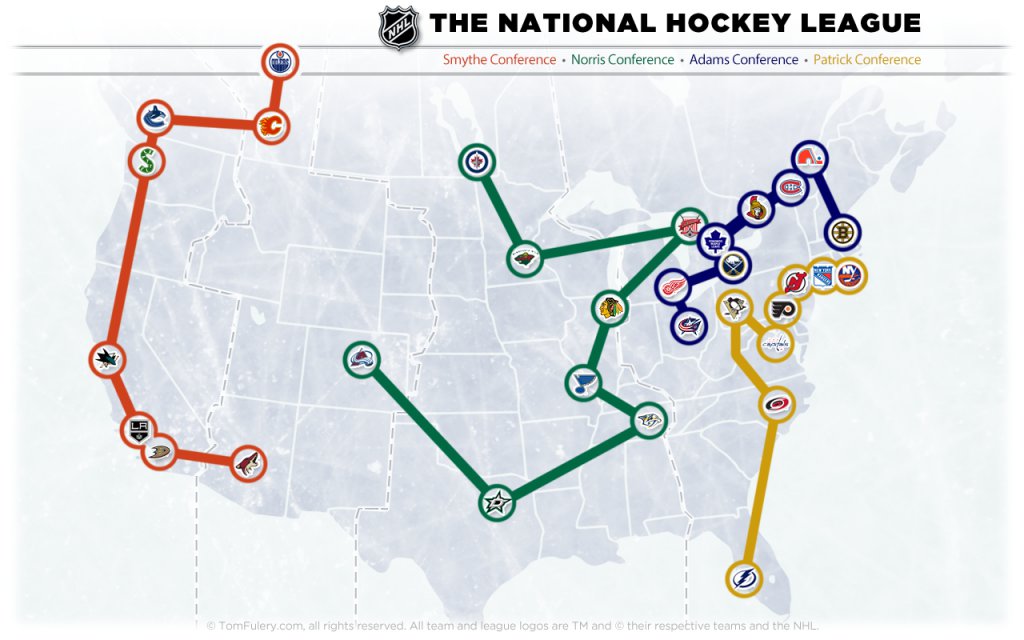
With the Seattle arena thing still in the news we’re gonna run with the very viable scenario of the only change in the NHL for 2012-13, team-wise would be a relocation of the Phoenix Coyotes franchise from their home in the desert to the Pacific Northwest’s Emerald City, Seattle. (NOTE: Yes, I am aware of the fact that there has been a bit of buzz around a potential Coyotes buyer being approved by the league (meaning they approve of him to potentially buy the team, not they have approved the sale itself), but we’ll deal with the implications of that next week). So let’s look at a PHX-to-SEA move.


The Map:

NHL Realignment Map - Week 39

NHL Realignment Map - Week 39

The Breakdown:

Those of you who are fans of the current league set-up will (mostly) love this. We’re sticking with the two conferences, made up of three 5-team divisions set-up that has been the league’s preference since 1998 (aside: see sixteenwins‘ infographic on all of the league’s realignments over the years). Of all the realistic scenarios based on the current format, this is probably my favorite… not to mention one I wouldn’t be surprised seeing implemented (at least until expansion or the Islanders, Panthers, Jackets, Lightning, and/or Hurricanes throw a wrench into the works).

Seattle’s addition means there are actually five teams in the Pacific time zone (and on/near the Pacific Ocean for that matter), so that makes that division name make sense for the first time ever. Peeling Vancouver away from the two Alberta teams will undoubtedly ruffle some feathers, but replacing them with a rival in an amazing city only a three-ish hour bus ride away from their home makes up for it. Pulling Dallas out of the Pacific and Winnipeg out of the Southeast rounds out the “sensible” moves we’re implementing. Detroit’s yearning to be in the Eastern Conference has unfortunately not been appeased, but hopefully a smarter scheduling will make them a little less sad).


The Wayne Douglas Gretzky Conference
Pacific Mountain West Central
Anaheim Ducks Calgary Flames Chicago Blackhawks
Los Angeles Kings Colorado Avalanche Dallas Stars
San Jose Sharks Edmonton Oilers Detroit Red Wings
Seattle Totems Minnesota Wild Nashville Predators
Vancouver Canucks Winnipeg Jets St. Louis Blues
The Robert Gordon Orr Conference
Northeast Atlantic Southeast
Boston Bruins New Jersey Devils Carolina Panthers
Buffalo Sabres New York Islanders Columbus Blue Jackets
Montreal Canadiens New York Rangers Florida Panthers
Ottawa Senators Philadelphia Flyers Tampa Bay Lightning
Toronto Maple Leafs Pittsburgh Penguins Washington Capitals


Gained Teams:

Seattle


Lost Teams:

Phoenix


The Benefits:

• Geography — No division is made up of more than two time-zones. Other than the Mountain West  and Central divisions, all of the divisions enjoy single time-zone status.

• Travel — Despite the fact that Detroit is still in the West, their long travels are a thing of the past ,with the new schedule (see SCHEDULING below).

• All-inclusive — Every team visits every other team’s building. The fact that this hasn’t been league policy for so long is a travesty.

• Rivalries —  Other than VAN/EDM and VAN/CGY, all of the major rivalries are preserved. And in all honesty, the Alberta rivalry is so intense between those two teams, the Canucks are mostly an “I guess we’re rivals” rival.


Scheduling:

Divisional Games: 4 home & 4 away vs. 4 teams = 32 games

Non-Divisional Games (both conferences): 1 home & 1 away vs. 25 teams = 50 games

TOTAL = 82 games

NOTE: I know a lot of folks will bitch about the amount of in-division games being too high, but if you think about it, teams will have 16 home games against division opponents and 25 against non-division opponents. That doesn’t seem too out of balance to me. Home games against division opponents can be done in pairs like the AHL is known to do (i.e. DET hosts CHI on a Friday and then again the next night on Saturday… how intense would that be?!). 


Playoffs:

Same as current format: 8 qualifiers from each conference. Division winners seeded 1-3. Next five best records in the conference seeded 4-8. Reseed after the first round.

(H/T to oilersnation.com for the original map)


Don’t forget to share our lil’ project with your hockey fan friends. And, as always, thanks for reading. Until next Sunday!

— TF

Make sure to check out the entire NHL Realignment Project ».


Watch Mike Ribeiro’s sick OT game winner; listen to Razor’s sicker commentary (VIDEO) | Puck Daddy – Yahoo! Sports

Big fan of Darryl “Razor” Reaugh for years. I was too busy with spillover work from the ol’ job last night to watch this game, and man, am I upset about it now. To have seen this in real-time with the drama of overtime would have been awesome. Razor’s commentary is just the cherry on top.

Thankfully, modern society has seen fit to give us video cameras, replays, and the internet, so I can relive this.

Big ups to Greg Wyshnski for giving even bigger ups to Razor in his post.

Watch Mike Ribeiro’s sick OT game winner; listen to Razor’s sicker commentary (VIDEO) | Puck Daddy – Yahoo! Sports ».

NHL Realignment Project – Week 38

NHL Realignment Project - Week 38

Something Old, Something New(s)

My insomnia has served me well this evening. In addition to finally having a moment to finish up this week’s (very late) entry, I’ve gotten wind of the interesting news that sometime on Thursday, a plan for an NBA/NHL arena to be built in Seattle will be revealed. Check the Seattle Times for the story.

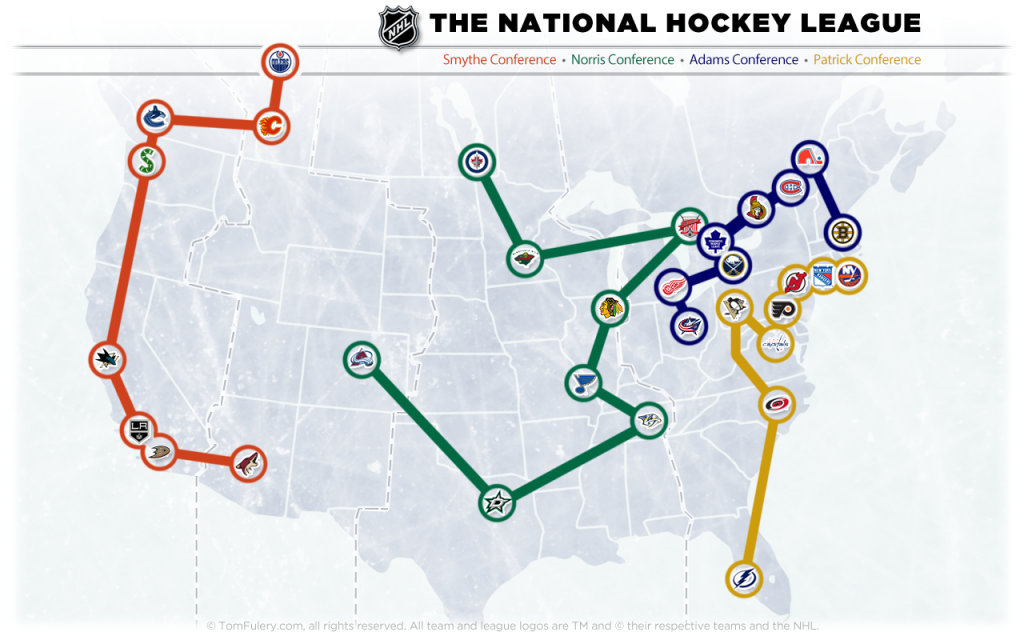
Anyhoo, I had planned on going with contraction this week, but this news has forced me to put that off until next week and do yet another realignment scenario with Seattle involved. Toss in the addition of a Salt Lake City team, and we’ve got “something new” covered (even though the city has won a Stanley Cup in the past). I’ve decided to balance out the “newness” with some “oldness”, so we’re giving three former NHL cities a team again. Let’s check the deets…


The Map:

NHL Realignment Map - Week 38

NHL Realignment Map - Week 38


The Breakdown:

Behold! The return of the 4-Confernce NHL! We’re naming them after our old skool division names—Patrick, Adams, Norris, and Smythe. Eight teams in each division giving us a total of 32 teams. For scheduling reasons only, each conference his subdivided into two 4-team scheduling pods. Looking at the map, you’ll see the two pods in each conference separated thin, double-line. This is a rehashing of our genius plan from many weeks back to allow for a smarter, more-balanced, and more travel-freindly schedule. Please do not confuse these scheduling pods for divisions… a teams primary goal in a season is to finish in the top-four in its conference to qualify for the playoffs, pods have nothing to do with standings. Just scheduling… got it? Cool.

Smythe Conference
Calgary Flames Anaheim Ducks
Edmonton Oilers Los Angeles Kings
Seattle Totems San Jose Sharks
Vancouver Canucks Utah Coyotes
Norris Conference
Colorado Avalanche Chicago Blackhawks
Dallas Stars Detroit Red Wings
Minnesota Wild Nashville Predators
Winnipeg Jets St. Louis Blues
Adams Conference
Buffalo Sabres Boston Bruins
Hamilton Tigers Hartford Whalers
Ottawa Senators Montreal Canadiens
Toronto Maple Leafs Quebec Nordiques
Patrick Conference
New Jersey Devils Carolina Hurricanes
New York Rangers Florida Panthers
Philadelphia Flyers Tampa Bay Lightning
Pittsburgh Penguins Washington Capitals


Gained Teams:

Seattle, Salt Lake City, Quebec City, Hamilton, Hartford


Lost Teams:

Phoenix, New York Islanders, Columbus Blue Jackets


The Benefits:

• Geography — In a reasonably decent effort (if I do say so myself), the conferences are pretty geographically sound. The one beef someone might have is the DET/COL jaunt, but if that’s the only two-time-zone jump anyone has to make, I think we’re good… and compared to what the Wings currently deal with, I’m sure they won’t mind. Plus those teams have some nasty history… it’ll be fun.

• Travel — Games outside your conference consist of one home and one away game per team, minimizing the longest of the NHL’s trips. Scheduling pods lessen the longer trips within conference as well. Win-win.

• Rivalries —  We keep CHI/DET, NYR/NJD, PIT/PHI, MTL/BOS, so everyone should be satisfied there. The revived rivalries of BOS/HRT, QBC/MTL and the new rivalries of SEA/VAN and TOR/HML will only serve to make the NHL even awesomer…est.

• Heritage —  C’mon! The division names are awesome. Hockey is special, it’s time the conference names reflected that anew.


Scheduling:

In-Conference/In-Pod: 3 home & 3 away vs. 3 teams = 18 games

In-Conference/Non-Pod: 2 home & 2 away vs. 4 teams = 16 games

Non-Conference: 1 home & 1 away vs. 24 teams = 48 games

TOTAL = 82 games


Playoffs:

Top four teams from each conference qualify for the playoffs.

First and second round of the playoffs determine Conference champions and give us our Final Four.

Final Four team with the best record chooses its opponent for the Semi-final round (will be cool to see what factors will go into this choice—travel distance, least-hot goalie, how tired an opponent might be from previous series, etc.)

Two Semi-finals winners square off in the Stanley Cup Finals

(H/T to oilersnation.com for the original map)


Don’t forget to share our lil’ project with your hockey fan friends. And, as always, thanks for reading. Until next Sunday!

— TF

Make sure to check out the entire NHL Realignment Project ».


Red Wings shoot for NHL home record vs. Flyers – chicagotribune.com

Dear, my teams,

I’d be ecstatic with a home winning streak half this long… okay, a quarter.

Sincerely,

Tom


Red Wings shoot for NHL home record vs. Flyers – chicagotribune.com.

Revisiting a Classic-NHL Soccer Jerseys

NHL Soccer Jerseys

One of my favorite things from last year was this bit of awesomeness from Majupra of Reddit Hockey. All 30 NHL teams’ jerseys re-imagined as soccer kits. Love the look of ‘em all. Love the effort. Love the realism of including the (mostly arena) sponsors.

Great work deserves a second look. Check’em out on Imgur »


NHL Realignment Project – Week 37


NHL Realignment Project - Week 37

West, west, west, west, east

This week we’re adding four new teams to the map west of the Gretzky-Orr line (two via expansion and two via relocation). Just to make sure the eastern side of the map doesn’t feel completely neglected we’ve allowed another relocation to stay within the Orr Conference. The Pacific Northwest has a love of hockey that is untapped and the MLS is showing us that the Vancouver/Seattle/Portland corridor has great fans that love great rivalries with their “neighbors”. Houston and KC round out the central part of our map and Quebec gets the team they deserve. I also threw Columbus a bone, and let them keep their team this week. Let’s check it out.


The Map:

NHL Realignment Map - Week 37

NHL Realignment Map - Week 37


The Breakdown:

We’re going with a 2 conferences of 2 divisions each format. Again, we’ve named the conferences are  for Gretzky and Orr while the division names are our old favorites—Patrick, Adams, Norris, and Smythe. Eight teams in each division giving us a total of 32 teams.

The Wayne Douglas Gretzky Conference
Smythe Division Norris Division
Anaheim Ducks Chicago Blackhawks
Calgary Flames Colorado Avalanche
Edmonton Oilers Dallas Stars
Los Angeles Kings Houston Aeros
Portland Eagles Kansas City Scouts
San Jose Sharks Minnesota Wild
Seattle Totems St. Louis Blues
Vancouver Canucks Winnipeg Jets
The Robert Gordon Orr Conference
Patrick Division Adams Division
Buffalo Sabres Boston Bruins
Columbus Blue Jackets Carolina Hurricanes
Detroit Red Wings Montreal Canadiens
Nashville Predators New Jersey Devils
Philadelphia Flyers New York Rangers
Pittsburgh Penguins Ottawa Senators
Tampa Bay Lightning Quebec Nordiques
Toronto Maple Leafs Washington Capitals

Gained Teams:

Seattle, Portland, Kansas City, Houston, Quebec City


Lost Teams:

Miami, Long Island, Phoenix


The Benefits:

• Geography — Like last week, every team has to travel to Canada for divisional games. Every division is stretched vertically (the two easternmost a little less, but still very stretchy), so that is reasonably equal as well. All this means that nobody can whine about “Our travel leaves us at a massive disadvantage”.

• Travel — Once again, North-South is the way. Divisional games may necessitate long trips, but again, staying within your time zone or only having to travel one over makes all the difference for player fatigue and for TV ratings.

• Rivalries —  Though we lose CHI/DET, we do get TOR/DET… not bad. The NYR/NJD, the Alberta teams, Pennsylvania teams, and BOS/MTL all stay together too, so check that off your list. New teams give us great rivalries too, SEA/POR/VAN, DAL/HOU, KC/STL

• Heritage —  C’mon! The division names are awesome. Hockey is special, now the conference and division names reflect that.


Scheduling:

Divisional Games: 3 home & 3 away vs. 7 teams = 42 games

Non-Divisional Games: 1 home & 1 away vs. 24 teams = 48 games

TOTAL = 90 games—yay, more hockey.


Playoffs:

Top three from each division qualify, plus next two best records from the conference (as wildcards).

Division Champs seeded 1 & 2, based on record. All other qualifiers seeded 3-8, based on record (so yes, a wildcard can have a higher seed than a top-three qualifier. This keeps the regular season more interesting and division-focused, as finishing top-three is the first ticket into the playoffs. Wildcard is just a backdoor option to keep things a little fair for 4th and 5th placed teams in a division who is having “a super-stacked-with-awesomeness year”.

Once qualification happens (division-centric), other than division champions getting 1 & 2, it’s all about your record for seeding (conference-centric). This way we are more likely to avoid a “two-best-teams-meeting-too-early-in-the-playoffs scenario”.

(H/T to oilersnation.com for the original map)


Don’t forget to share our lil’ project with your hockey fan friends. And, as always, thanks for reading. Until next Sunday!

— TF

Make sure to check out the entire NHL Realignment Project ».


NHLRP—Inspiring The World (Now With Updates)

The Original:

Inspired by our lil’ blog, NHLRP reader, AgentJ offers up his very own version of a realigned NHL. Read it here.

I especially enjoyed the idea of moving one of the L.A.-area teams down to San Diego… I’ve toyed with that a few times in planning some of my scenarios, but never did it. Now if I ever include that move in one of my weekly entries, AgentJ will be all, “Tom is a total biter! That was my idea.” :) What can I do. First to market wins.

To all you other aspiring NHL Fools, if you’ve enjoyed this blog and have your own plans you’d like pimped on these pages, just drop me a line in the comments and I’ll hook you up. All I ask in return is a link back here.

Thanks, all, and keep on readin’

—TF

UPDATES:

Reader, GlenR has an in-depth look at the options for Phoenix’s relocation. Check it our here. The effort is worth a stick tap AND a hat tip. Nicely done.

Random Hockey Book of the Week – Wk10

Week 10: The Code: The Unwritten Rules of Fighting and Retaliation in the NHL
After many weeks in the dark, this feature is back! The Random Hockey Book of the “Week” returns in all it’s splendor with a book that will make Brendan Shanahan rollover in his plush office chair in the League offices. Read all about fighting and the other dark arts in the NHL before they are banned.

Enjoy…

Via Amazon:

The Code: The Unwritten Rules of Fighting and Retaliation in the NHL

“Ice hockey has always been a sport steeped in a culture of violence, and players universally calibrate the level of physical contact by adhering to unwritten rules known simply as “the code”. “The Code” picks up where the rule book leaves off and fills in the gaps, all in an effort to govern the game and its players – allowing them to complete in a manner deemed fair and respectable. To fully understand the significance and history behind “the code”, Bernstein interviewed more than 50 past and present players and coaches. Their insights and stories explain why fighting is allowed, and how players police themselves on and off the ice.”

— Amazon

NHL Realignment Project – Week 36

NHL Realignment Project - Week 36

Getting Vertical, Eh!

Only a day late this week! Getting better.

So this week we’re not quite as farcical as in the past few weeks, but haven’t completely re-entered the world of “reality-based” realignment either. This week’s theme is all about going Canadian. By relocating some teams and re-jiggering the divisional alignments, we’ve been able to get at least one Canadian team in each division. Let’s have a look at how this plays out.


The Map (Complete with goofball division names based on landmarks found at the border):

NHL Realignment Map - Week 36
NHL Realignment Map – Week 36

The Breakdown:

We’re going with the current 2 conferences of 3 divisions each format. The conferences are named for Gretzky and Orr while the division names are a little more fun—they are named for landmarks found at the borders, more-or-less where one might cross to visit the Canadian team(s) in your division… well, if the boys weren’t crossing tens-of-thousands of feet overhead in first-class luxury. This includes border straddling bridges, airports, monuments, etc. Obviously this would never fly, but whatever. Its fun.

The Wayne Douglas Gretzky Conference
Peace Arch Chief Mountain Piney Pinecreek
Anaheim Ducks Calgary Flames Chicago Blackhawks
Los Angeles Kings Colorado Avalanche Dallas Stars
San Jose Sharks Edmonton Oilers Minnesota Wild
Seattle Metropolitans Las Vegas Scorpions St. Louis Blues
Vancouver Canucks Utah Coyotes Winnipeg Jets
The Robert Gordon Orr Conference
Ambassador Thousand Islands Blackpool
Detroit Red Wings Buffalo Sabres Boston Bruins
Florida Panthers Carolina Hurricanes Montreal Canadiens
Nashville Predators Ottawa Senators New Jersey Devils
Tampa Bay Lightning Pittsburgh Penguins New York Rangers
Toronto Maple Leafs Philadelphia Flyers Washington Capitals

Gained Teams:

Seattle, Salt Lake City, Las Vegas


Lost Teams:

Phoenix, Long Island, Columbus


The Benefits:

• Equality — Every team has to travel to Canada for divisional games (Las Vegas, Colorado and Utah need to do it a little more often… but I wasn’t about to break up the Alberta rivalry). Every division is stretched vertically (the two easternmost a little less, but still somewhat stretchy), so that is reasonably equal as well. All this means that nobody can whine about “Our travel leaves us as a massive disadvantage”. Even previously all alone Colorado gets a fairly near neighbor in the new Salt Lake City franchise.

• Travel — North-South is the way. Divisional games may necessitate long trips, but again, staying within one time-zone makes all the difference for player fatigue and for TV ratings.

• Rivalries —  Though we lose CHI/DET, we do get TOR/DET… not bad. The NYR/NJD, the Alberta teams, Pennsylvania teams, and BOS/MTL all stay together too, so check that off your list. All apologies to fans who live for the BUF/TOR games, but somebody has to sacrifice for the good of the league, right?


Scheduling:

Divisional Games: 3 home & 3 away vs. 4 teams = 24 games

Non-Divisional Games: 1 home & 1 away vs. 25 teams = 50 games

One additional home-and-away series against a conference opponent from each of the two divisions not your own (a five-year cycle that rotates through the conference) = 4 games

TOTAL = 78 games (bonus: we get to the playoffs quicker)


Playoffs:

Same as current format.

(H/T to oilersnation.com for the original map)


Don’t forget to share our lil’ project with your hockey fan friends. And, as always, thanks for reading. Until next Sunday!

— TF

Make sure to check out the entire NHL Realignment Project ».