Oh, You Want a RADICAL Realignment?

You all knew I wouldn’t be able to stop.

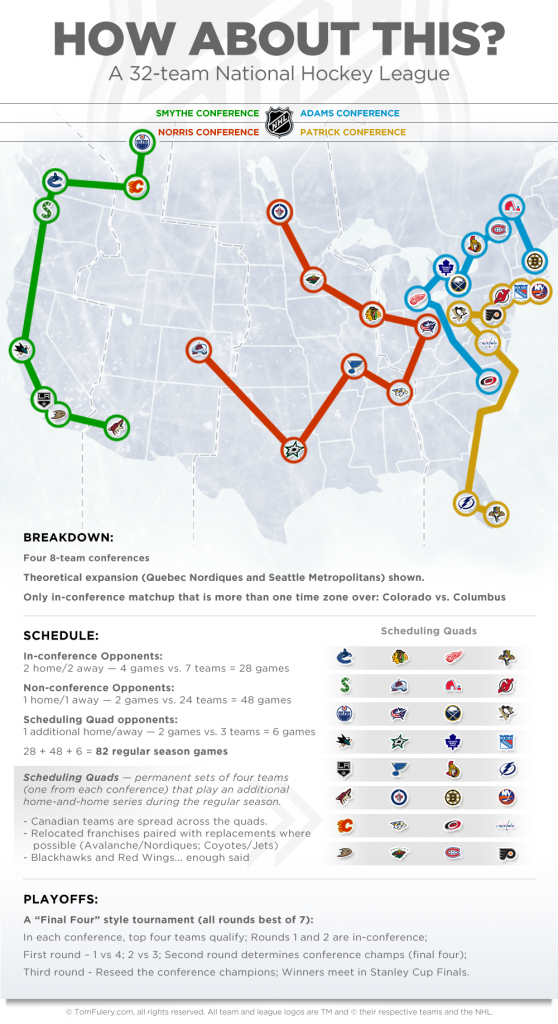
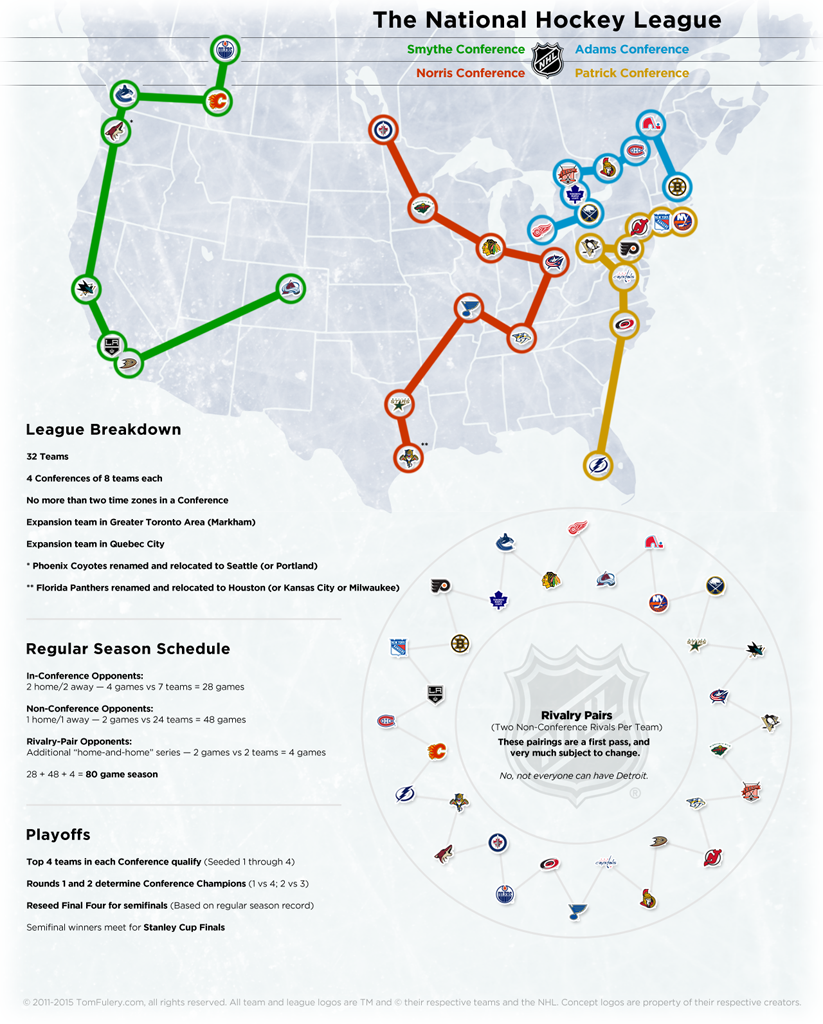
Here is the most radical, yet positively doable re-imagining of the NHL yet. It’s a crazy hybridization of the plans being tossed around lately, plus relocation and expansion. It addresses the biggest gripe of the latest realignment—Chicago losing Detroit as a more-than-two-games-per-season opponent. It does however keep the other gripe that half(ish) fans have, the “final four” playoff style. Also, since we’ve upped to 32 teams, there shall be no whining about uneven/unfair playoff chances.

The key to it all is this: In addition to Conference opponents, each team gets two non-confence rivals which whom they have an additional home-and-home series. I picked the pairings based on previous rivalry history (i.e. Chicago/Detroit), relocation history (i.e. Quebec City/Colorado), Stanley Cup finals history (i.e. LA/Montreal). These pairings can obviously be tweaked, but the idea is there, and dare I say, really interesting to me.

I’ll stop talking now… other than to apologize to the fans in Miami and Phoenix.

Additional Note: Florida to Houston could just as easily be to Kansas City or Milwaukee or some other Central Time Zone city.

Click the image to enlarge and read the details:

Radical NHL Realignment — Crazy can sometimes work.

Radical NHL Realignment — Crazy can sometimes work.

NHL Realignment Project – Week 51


NHL Realignment Project - Week 51

A More Balanced East

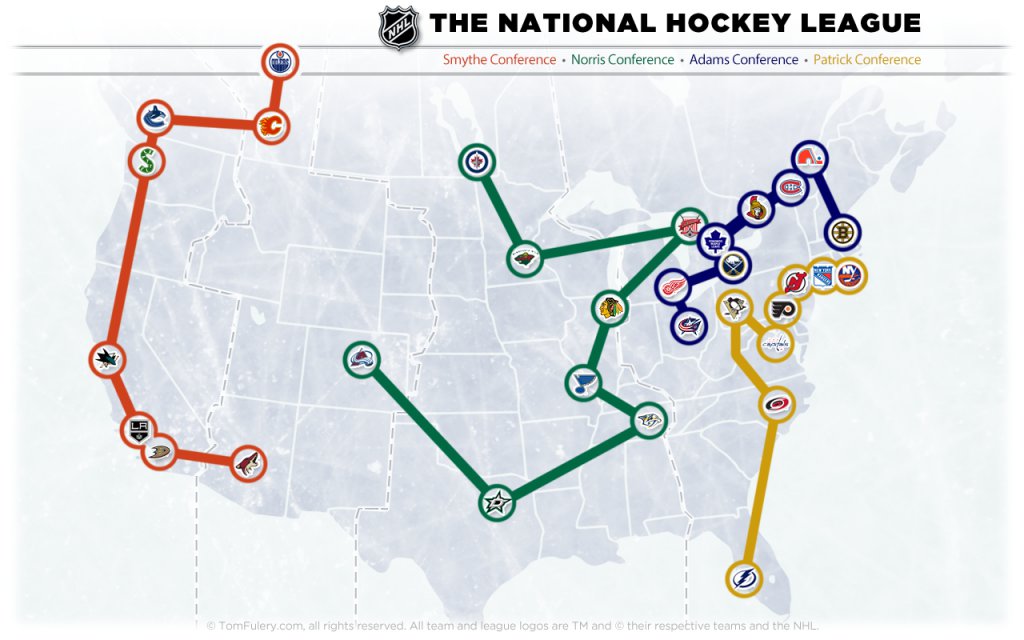
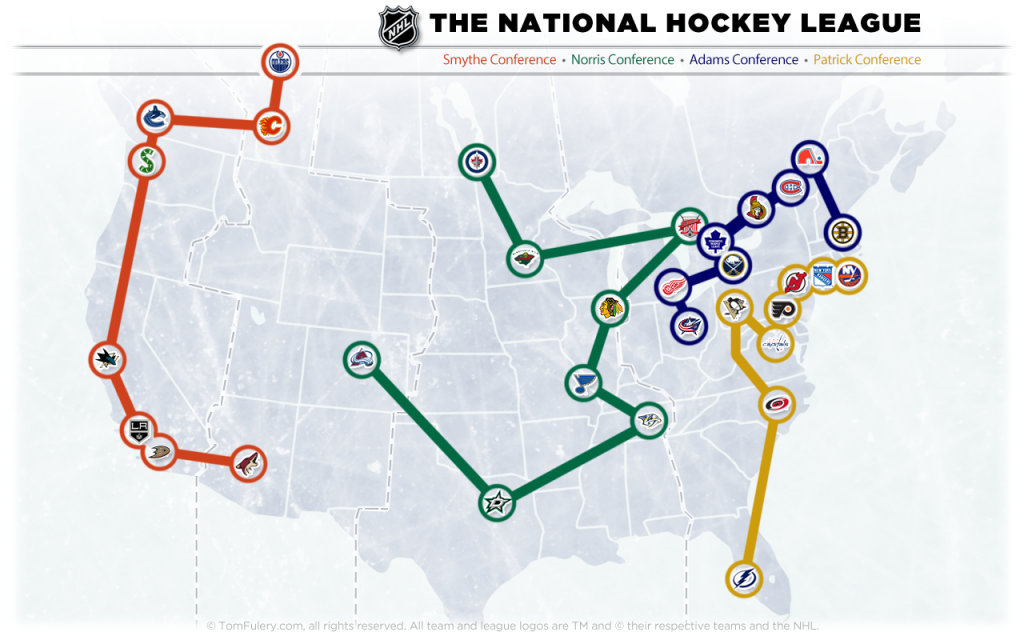
Last week’s realignment got a little feedback on here and on Twitter that despite my best efforts, a few to many important rivalries got split up. Consider this week’s map a tweak of last week’s. While of course there is no silver bullet that will please all people and teams (hence this blog’s slogan “endless possibilities, no consensus), I think this is the best addressing of rivalries of the entire project thus far. An additional by-product of the tweaks is a more balanced set of teams in the two conferences on the east side of the map. Havalook:

The Map:

NHL Realignment Project - Week 51

NHL Realignment Project – Week 51

The Breakdown:

Once again, this week’s re-imagined league continues to use the NHL’s four-conference breakdown proposed last year. I’ve gone with the common names of the Stanley Cup winning teams from Seattle and Quebec—the Metropolitans and Bulldogs respectively. Side note: the Quebec Stanley Cup champs were only informally knowns as the Bulldogs, they were officially the Quebec Hockey Club at the time. I’m not advocating these names, my preference would be to let people from each of the cities vote on names vetted presented by the two franchises… none of that “let the people submit names for voting or using something hip at the time that will seem stupid in a couple of years” crap — I’m looking at you, Toronto RAPTORS! *facepalm* But for the map this week, I just when with the Metropolitans and the Bulldogs.

Again, conference names are an homage to the greatest players (arguably, of course) in the history of the teams of that conference. Gretzky (Oilers and Kings); Howe (Red Wings); Orr (Bruins); Lemieux (Penguins).

GRETZKY CONFERENCE
Anaheim Ducks
Calgary Flames
Colorado Avalanche
Edmonton Oilers
Los Angeles Kings
San Jose Sharks
Seattle Metropolitans
Vancouver Canucks
HOWE CONFERENCE
Chicago Blackhawks
Colorado Avalanche
Dallas Stars
Detroit Red Wings
Minnesota Wild
Nashville Predators
St. Louis Blues
Winnipeg Jets
ORR CONFERENCE
Boston Bruins
Buffalo Sabres
Columbus Blue Jackets
Montreal Canadiens
Ottawa Senators
Quebec Bulldogs
Toronto Maple Leafs
Washington Capitals
LEMIEUX CONFERENCE
Carolina Hurricanes
Florida Panthers
New Jersey Devils
New York Islanders
New York Rangers
Philadelphia Flyers
Pittsburgh Penguins
Tampa Bay Lightning


Gained teams:

Seattle, Quebec City


Lost teams:

none


The Benefits:
• Rivalries — Like I mentioned earlier in this post, with reader inputs I’ve done my best work so far in keeping most of the major rivalries together. The more obvious ones are all here, of course, but even the “secondary” ones like the Sabres and the Leafs have been maintained where possible. Some of the Howe Conference teams could evolve into good rivalries too, like Dallas and Nashville. And to all you who constantly complain that the PHI/NYR rivalry is more important than the PIT/PHI rivalry—once again, the Broadway Blueshirts and the Broad Street Bullies and kept together. Oh, and Detroit and Colorado are together now… you’re welcome.

• Travel — Four conferences cut down on travel for the teams that currently have the heaviest burden (mainly Dallas, Winnipeg, Minnesota). Some of the teams with the light travel burdens right now add a little more (looking at you Lemieux Conference), but are still in much better shape than the  frequent-flier champs out west. The only teams that have to got beyond one additional time zone for any in-conference game are the aforementioned Red Wings and Avalanche… and just to play each other. With that hatred, they won’t mind a bit.

• Heritage — The conferences are named for some of the greats from the history of the game. Only issue with this is having only four will spark countless debate on the choices (where are Richard, Kennedy Plante, Hull, Bossy, Smith, Lafleur, etc.)

Erin Andrews — With both her faves in one conference (The Lightning and the Rangers), we can only expect more tweets, mentions and other additional exposure to the Queen of All Media (Oprah retired). I welcome all of it.


Scheduling:

Each team plays:

- against its seven conference-mates twice at home and twice on the road each:
 4 games x 7 teams = 28 games

- against the teams in the other conferences once at home and once on the road:
2 games x 24 teams = 48 games

- half of each conference pair up and play an additional home-and-home series (switch the pairings each season):
2 games x 3 teams = 6 games

28 + 48 + 6 = 82 game season
Playoffs:

• Top four teams from each conference qualify for a “final four” style tournament. All series are best of seven.

• Round 1: Conference Semifinals (1 seed vs. 4 seed; 2 vs. 3  (based on overall record))

• Round 2: Conference Finals (first round winners play each other)

• Round 3: Stanley Cup Semifinals (best overall record of remaining teams picks it’s opponent for this round)

• Round 4: Stanley Cup Finals

As always, thanks for reading, and don’t forget to use the sharing buttons to spread the word and wish me luck on my impending fatherhood in February.


—Tom

NHL Realignment Project – Week 50


Bulldogs and Metropolitans

This week’s realignment is somewhat inspired by the “Lords of the Stanley Cup” infographic I did last week. In expanding to a 32-team league (which is something most believe the NHL will do soon), I picked the larger two cities of the four that have had Stanley Cup championships in the past, but no longer have teams: Seattle and Quebec City (the other two are Victoria, BC and Kenora, ON, in case you’re curious). This idea is also reinforced by the poll we’ve got running showing those two cities being the ones with the highest support for NHL expansion (yes, I know it’s not scientific, and no, I don’t think I am Nate Silver or anything).

This is no far-fetched scenario, with Markham’s arena deal hitting the skids lately, this may actually be the way things turn out.

The Map:

NHL Realignment Map - Week 50

NHL Realignment Map – Week 50


The Breakdown:

This week’s re-imagined league continues to use the NHL’s four-conference breakdown proposed last year. I’ve gone with the common names of the Stanley Cup winning teams from Seattle and Quebec—the Metropolitans and Bulldogs respectively. Side note: the Quebec Stanley Cup champs were only informally knowns as the Bulldogs, they were officially the Quebec Hockey Club at the time. Conference names are an homage to the greatest players (arguably, of course) in the history of the teams of that conference. Gretzky (Oilers and Kings); Howe (Red Wings); Orr (Bruins); Kennedy (Maple Leafs).

GRETZKY CONFERENCE
Anaheim Ducks
Calgary Flames
Colorado Avalanche
Edmonton Oilers
Los Angeles Kings
San Jose Sharks
Seattle Metropolitans
Vancouver Canucks
HOWE CONFERENCE
Chicago Blackhawks
Colorado Avalanche
Dallas Stars
Detroit Red Wings
Minnesota Wild
Nashville Predators
St. Louis Blues
Winnipeg Jets
ORR CONFERENCE
Boston Bruins
Montreal Canadiens
New Jersey Devils
New York Islanders
New York Rangers
Philadelphia Flyers
Pittsburgh Penguins
Quebec Bulldogs
KENNEDY CONFERENCE
Buffalo Sabres
Carolina Hurricanes
Columbus Blue Jackets
Florida Panthers
Ottawa Senators
Tampa Bay Lightning
Toronto Maple Leafs
Washington Capitals


Gained teams:

Seattle, Kansas City, Quebec City


Lost teams:

none


The Benefits:
• Media — With one conference boasting all eight members as previous Stanley Cup winners, we might score a bit of a running narrative for TV/print/electronic media to latch on to. Kind of like the SEC has in college football now. The teams in the Orr will obviously hate each other a ton, but will have a strange kinship in that there’s is the only conference with the “all champs” distinction. This “better than the rest” attitude will further fuel this 8 teams efforts, and more importantly fuel the other three conferences to step up and dethrone them… just like the Big Ten, Big 12 and Pac 12 do in the NCAA.

• Rivalries — Once again, I’ve tried my best to keep most of the major rivalries together. The more obvious ones are all here, of course, but even the “secondary” ones like the Sabres and the Leafs have been maintained where possible. Some of the Howe Conference teams could evolve into good rivalries too, like Dallas and Nashville. And to all you who constantly complain that the PHI/NYR rivalry is more important than the PIT/PHI rivalry—once again, the Broadway Blueshirts and the Broad Street Bullies and kept together. Oh, and Detroit and Colorado are together now… you’re welcome.

• Travel — Four conferences cut down on travel for the teams that currently have the heaviest burden (mainly Dallas, Winnipeg, Minnesota). Some of the teams with the light travel burdens right now add a little more (looking at you Kennedy Conference), but are still in much better shape than the frequent-flier champs out west. The only teams that have to got beyond one additional time zone for any in-conference game are the aforementioned Red Wings and Avalanche… and just to play each other. With that hatred, they won’t mind a bit.

• Heritage — The conferences are named for some of the greats from the history of the game. Only issue with this is having only four will spark countless debate on the choices (where are Richard, Plante, Hull, Bossy, Smith, Lafleur, etc.)


Scheduling:

Each team plays:

- against its seven conference-mates twice at home and twice on the road each:
 4 games x 7 teams = 28 games

- against the teams in the other conferences once at home and once on the road:
2 games x 24 teams = 48 games

- half of each conference pair up and play an additional home-and-home series (switch the pairings each season):
2 games x 3 teams = 6 games

28 + 48 + 6 = 82 game season
Playoffs:

• Top four teams from each conference qualify for a “final four” style tournament. All series are best of seven.

• Round 1: Conference Semifinals (1 seed vs. 4 seed; 2 vs. 3  (based on overall record))

• Round 2: Conference Finals (first round winners play each other)

• Round 3: Stanley Cup Semifinals (best overall record of remaining teams picks it’s opponent for this round)

• Round 4: Stanley Cup Finals

As always, thanks for reading, and don’t forget to use the sharing buttons to spread the word and wish me luck on my impending fatherhood in February.


—Tom

If ever there is an NHL again, where would you like to see it expand?

NHLRPNHL Expansion — If you were in charge, where would you put an expansion franchise? Select from the list below or add your own. You’re limited to one vote every 24 hrs, but other than that, come back and vote as often as you like to make your voice louder in the debate.


NHL Realignment Project – Week 49

NHL Realignment Project - Week 49


Gary’s Dream – With a Little Barbecue Sauce

So, last week we outlined a version of the NHL that could very conceivably be something Gary Bettman could steer the league towards. The biggest caveat of the week was the issues that Markham seems to have run into with their arena plans. If we pull them out of the equation, and limit our relocation/expansion efforts to cities with arenas that have already been approved or have  been built, we end up with a slightly tweaked version of Gary’s dream (granted, to the league it would be a nightmare, because they would certainly not be as able to milk nearly as much out of expansion fees without the richest city in Canada).

The Sprint Center in Kansas City, the New Colisée in Quebec City, and the not-yet-named arena in Seattle are the sites of our expansion/relocation efforts in this installment.

Like last week, let’s make the assumption that from the short-lived realignment that the league proposed last year, the commish is interested in four conferences… which in turn, reflect and reinforce the idea of a 32-team league to even up the conferences at 8 teams each. And again, the proposed playoff format will piss off a ton of fans (and make another ton very happy somehow), but the trade off of having a more fair travel load across the league and the maintaining of most of the major rivalries in the league, might be worth it.

Besides, I’m willing to bet right now that most fans would be more than fine with a realignment and a re-working of the playoff format if it meant we got to watch some damn hockey again.


The Map:

NHL Realignment Map - Week 49

NHL Realignment Map – Week 49


The Breakdown:

This week’s re-imagined league brings back the NHL’s four-conference breakdown proposed last year (links provided for concept names/logos).

GRETZKY CONFERENCE
Anaheim Ducks
Calgary Flames
Colorado Avalanche
Edmonton Oilers
Los Angeles Kings
San Jose Sharks
Seattle Metros
Vancouver Canucks
HOWE CONFERENCE
Chicago Blackhawks
Columbus Blue Jackets
Detroit Red Wings
New Jersey Devils
New York Islanders
New York Rangers
Philadelphia Flyers
Pittsburgh Penguins
ORR CONFERENCE
Boston Bruins
Buffalo Sabres
Minnesota Wild
Montreal Canadiens
Ottawa Senators
Quebec Tempest
Toronto Maple Leafs
Winnipeg Jets
HULL CONFERENCE
Carolina Hurricanes
Dallas Stars
Florida Panthers
Kansas City Scouts
Nashville Predators
St. Louis Blues
Tampa Bay Lightning
Washington Capitals


Gained teams:

Seattle, Kansas City, Quebec City


Lost teams:

Phoenix


The Benefits:

• Rivalries — I tried my best to keep most of the major rivalries together. The more obvious ones are all here, of course, but even the “secondary” ones like the Sabres and the Leafs have been maintained where possible. Some of the Hull Conference teams could evolve into good rivalries too, like Dallas and Nashville and obviously Kansas City and St. Louis. And to all you who constantly complain that the PHI/NYR rivalry is more important than the PIT/PHI rivalry… once again, the Broadway Blueshirts and the Broad Street Bullies and kept together.

• Travel — Four conferences cut down on travel for the teams that currently have the heaviest burden (mainly Dallas, Winnipeg, Minnesota). Teams with the lightest travel burdens right now add a little more, but are still in much better shape than the frequent-flier champs. All conferences now span two time zones and none span three. Some of the old guard on the east coast won’t like this, but fair is fair.

• Heritage — The conferences are named for some of the greats from the history of the game. Only issue with this is having only four will spark countless debate on the choices (Richard, Plante, Kennedy, Bossy, Smith, Lafleur, etc.)


Scheduling:

Each team plays:

- against its seven conference-mates twice at home and twice on the road each:
 4 games x 7 teams = 28 games

- against the teams in the other conferences once at home and once on the road:
2 games x 24 teams = 48 games

- half of each conference pair up for an additional home-and-home series (switch the pairings each season):
2 games x 3 teams = 6 games

28 + 48 + 6 = 82 game season
Playoffs:

• Top four teams from each conference qualify for a “final four” style tournament. All series are best of seven.

• Round 1: Conference Semifinals (1 seed vs. 4 seed; 2 vs. 3  (based on overall record))

• Round 2: Conference Finals (first round winners play each other)

• Round 3: Stanley Cup Semifinals (best overall record of remaining teams picks it’s opponent for this round)

• Round 4: Stanley Cup Finals

As always, thanks for reading, and don’t forget to use the sharing buttons to spread the word and wish me luck on my impending fatherhood in February.


—Tom

NHL Realignment Project – Week 44

NHL Realignment Project - Week 44


There Is No Spoon

Neo, this message was intercepted from the machine communication network. It shows a system of “Bread and Circuses” that the machines have implemented to placate the masses. As we all know, some time in the early 21st Century (right after Gary Bettman relinquished his post), ice hockey overtook all other sports in North America to become THE main spectator sport for the region. The machines have realigned the sport in the Matrix to maximize it’s appeal and effectiveness, but in doing so have committed a fatal error in judgement (since they don’t have that capacity), they left out the people of Hamilton, Ontario… and everyone knows how rabid they are. Study this message and use it to incite a revolt starting in Southern Ontario and spreading across the continent then around the world! You must not fail, Chosen One, for if you do, they may reprogram the Matrix and make Baseball the most popular sport again… or worse, bring back Bettman. Godspeed!


——————– BEGIN INTERCEPTED MESSAGE ——————–

Electronic Memo to the Bread-and-Circuses Program—Your efforts to create and maintain a level of acceptance in the minds of the subjugated human fuel cells has been reviewed and deemed a success for the 1,917th cycle. We continue to approve of the use of the top 24 Combined Statistical Areas in the United States (with the inclusion of the largest standalone Metropolitan Statistical Areas of Miami, Phoenix, San Diego and Tampa) and the 8 largest Canadian Census Metropolitan Areas, for the broadest reach and most efficient population inclusion. The following data were written to the database for archiving:


The Map (based on a free wallpaper of the NHL created by some foolish human in 2012):

NHL Realignment Map - Matrix

NHL Realignment Map – Matrix


The Breakdown:

The breaking down of the league into two conferences of control is a legacy format based on the 1967 expansion and bifurcation of the NHL, and subsequently continued by a our operative, Agent Bettman upon achieving his super-admin post on February 1, 1993.

Each conference is further subdivided into four divisions to help further regional collectivism and rivalry (and thus facilitate control) of the humans therein.


Gained teams from the above-mentioned map:

Atlanta, Cleveland, Houston, Orlando, Quebec City, Sacramento, San Diego, Seattle


Lost teams from the above-mentioned map:

Columbus, Buffalo, Uniondale, Newark, Nashville, Anaheim


The Benefits:

• Efficient Dispersal of Most Effective Human Control Agent — Their love of their local hockey team and their loathing of the teams based in other locations (most notably accentuated by opposing teams situated within the same subdivision as their own).


Scheduling:

Each team plays its in-division opponents three times at home and three times on the road: 6 games x 3 teams = 18 games (played in home-and-home series)

Each team plays its in-conference opponents twice at home and twice on the road: 4 games x 12 teams = 48 games (played in home-and-home series)

Each team plays its out-of-conference opponents once at home and once  on the road: 2 games x 16 teams = 32 games (played in home-and-home series)

18 games + 48 games + 32 games = 98 games — ADDITIONAL NOTE: The injection of a fatigue-eliminating sub-program has been an unqualified success.


Playoffs (all series best-of-seven in 2-2-1-1-1 format):

• 4 division winners from each conference qualify for the playoffs (seeded #1-#4 by record)

• 4 best records amongst the non-division winners in each conference are awarded wild-card spots (seeded #5-#8 by record)

• Round One: Conference Quarterfinals — #1 vs #8, #2 vs #7, #3 vs #6, #4 vs #5 (home-ice advantage to higher seeded team)

• Round Two: Conference Semifinals — Highest seed vs lowest seed, 2nd highest vs 2nd lowest (home-ice advantage to higher seeded team)

• Round Three: Conference Finals — Remaining two teams in conference (home-ice advantage to higher seeded team)

• Round Four: Stanley Cup Finals — Conference Champions (home-ice advantage goes to team with the best record)


Continued Success,

Review Sub-Program — Department of Human Distraction

——————– END INTERCEPTED MESSAGE ——————–

Some notes and a very special thanks this week to the creators of some of the concepts used in the logos:

- Houston Sabres (based on current Buffalo logo)

- Orlando Devils (based on New Jersey Devils concept by Matthiason (DeviantArt Gallery))

- Quebec Tempest (concept by Ryan Barber (Icethetics feature))

- Sacramento Royals (I just crapped that one out, cuz I couldn’t find anything)

- San Diego Ducks (based on current Anaheim Ducks logo)

- Seattle Metros (concept by Ryan Haslett (Icethetics feature))

Don’t forget to share our lil’ project with your hockey fan friends. And, as always, thanks for reading. Until next Sunday!

— TF

Make sure to check out the entire NHL Realignment Project ».


NHL Realignment Project – Week 41

NHL Realignment Project - Week 41

Whale of a Tweak

These week’s entry is only five days late. Which is slightly different than last week’s six days late. In that spirit, this week’s NHL Realignment Scenario is only slightly different than last week’s… nooch!

I know the economic viability is a question, but everyone loves the idea of the Whalers (and their AWESOME uniforms) coming back into the league. for some reason we all have a soft spot for ‘em.

In order to accommodate this and keep last week’s structure, our league is gonna have to lose a team that few (especially Jeff Carter) have any kind of soft spot for… Columbus.

Let’s see the result (Those readers who are extra keen will notice a whole lot of copy/paste from last week… shhhhh!).

NHL Realignment Map - Week 41

NHL Realignment Map - Week 41


The Breakdown:

Two relocations plus two expansions equals a 32-team league. Our breakdown this week yields yet another four-conference alignment. Each conference is made up of 8-teams that are reasonably geographically clustered.

Pacific Conference
Anaheim Ducks Phoenix Coyotes
Calgary Flames San Jose Sharks
Edmonton Oilers Seattle Metros*
Los Angeles Kings Vancouver Canucks
Central Conference
Chicago Blackhawks Minnesota Wild
Colorado Avalanche Nashville Predators
Dallas Stars St. Louis Blues
Kansas City Scouts Winnipeg Jets
Northeast Conference
Boston Bruins Montreal Canadiens
Buffalo Sabres Ottawa Senators
Detroit Red Wings Quebec Tempest*
Hartford Whalers Toronto Maple Leafs
Atlantic Conference
Carolina Hurricanes Philadelphia Flyers
Florida Panthers Pittsburgh Penguins
New Jersey Devils Tampa Bay Lightning
New York Rangers Washington Capitals

*Bonus fun—This week, the new teams in Seattle and Quebec City get there names and logos from concepts put forth in the excellent blog, Icethetics. There is a concept page for the the Seattle Metros and the Quebec Tempest (or Tempête). Thought it would be fun to mix it up and give a shout out to a great blog and some amazing work by some of their readers.


Gained Teams:

Seattle, Quebec City, Kansas City, Hartford


Lost Teams:

Long Island, Columbus


The Benefits:

• The Whale — C’mon! It’s the whale. Even Brodie from Mallrats knows what’s up.

• Geography/Travel — No division is made up of more than two time-zones. No Eastern Time Zone teams are located in the Western half of the breakdown.

• All-inclusive — Every team visits every other team’s building. The fact that this hasn’t been league policy for so long is a travesty.

• Rivalries —  Other than CHI/DET, all major rivalries are preserved. And as Philly fan and reader of the blog noted this week, many Flyer fans would be more broken up about losing the Rangers and Devils as rivals than the Pens. Many would argue this statement and many would support it… so I made everyone happy and kept all four teams together.


Scheduling:

Conference Games: 2 home & 2 away vs. 7 teams = 28 games

Inter-Conference Games: 1 home & 1 away vs. 24 teams = 48 games

An additional Home-and-Away versus a single opponent in each of the conferences not your own (to rotate through the league every 8 years): 1 home & 1 away vs. 3 teams = 6 games

TOTAL = 82 games


Playoffs:

Top four in each conference qualify. First two rounds determine Conference Champions. Third round is the semi-finals (with the team with the best regular season record choosing his opponent). Fourth round is the Stanley Cup Finals.

(H/T to oilersnation.com for the original map)


Don’t forget to share our lil’ project with your hockey fan friends. And, as always, thanks for reading. Until next Sunday!

— TF

Make sure to check out the entire NHL Realignment Project ».


NHL Realignment Project – Week 40

NHL Realignment Project - Week 40

Arena Talk

Crazy deadlines at the real-world job pushed this week’s entry to a very late release… but here it is.

With the news of a potential buyer for the Phoenix franchise, it’s time we switched focus to arenas—who has them, who soon will and who can’t seem to get one built.

Phoenix has a good arena… and maybe with a new owner they can start to spend some money (on marketing, not just players) and people might start showing up to fill that areana (Dallas is going through the same thing now with their new owner Tom Gaglardi). So this week, we’re leaving the Coyotes in the desert and look at a few other cities and their arena situations (good and bad).

The good: Kansas City has an NHL-ready arena just sitting there. The city of Seattle seems to be on the brink of getting one in a year or two. Quebec City is finishing up last details for getting a brand spanking new arena started as well.

The bad: One of the biggest issues arena-wise is out on Long Island. With an owner wanting serious concessions/overtures from the good folks of Nassau County before committing to sticking around, let’s look at a “not-completely-out-of-the-realm-possibility” scenario that has the Islanders moving outta the market completely.

The preemptive strike: Yes I know there are other arena issues out there, but most are based on financial agreement issues (revenue sharing, lease terms), not on structural issues (bad sight lines, low capacity, no luxury boxes, etc). So we’re sticking with the Islanders this week. But I’m sure others fit the mould too.

With three revenue-generating arenas ready or soon to be ready, it’s kind of hard to believe Gary when he says that expansion is not  in the NHL’s near-future (c’mon, did you think the NHL was going was going to allow the league to stay unbalanced for more than a couple of years with their proposed alignment). Expansion fees are where the money’s at for the league… not so much relocation fees. So how do all these pieces fit together? Let’s go to the map:


The Map:

NHL Realignment Map - Week 40

NHL Realignment Map - Week 40

The Breakdown:

One relocation plus two expansions equals a 32-team league. Our breakdown this week yields yet another four-conference alignment. Each conference is made up of 8-teams that are reasonably geographically clustered.

Pacific Conference
Anaheim Ducks Phoenix Coyotes
Calgary Flames San Jose Sharks
Edmonton Oilers Seattle Metros*
Los Angeles Kings Vancouver Canucks
Central Conference
Chicago Blackhawks Minnesota Wild
Colorado Avalanche Nashville Predators
Dallas Stars St. Louis Blues
Kansas City Scouts Winnipeg Jets
Northeast Conference
Boston Bruins Montreal Canadiens
Buffalo Sabres Ottawa Senators
Columbus Blue Jackets Quebec Tempest*
Detroit Red Wings Toronto Maple Leafs
Atlantic Conference
Carolina Hurricanes Philadelphia Flyers
Florida Panthers Pittsburgh Penguins
New Jersey Devils Tampa Bay Lightning
New York Rangers Washington Capitals

*Bonus fun—This week, the new teams in Seattle and Quebec City get there names and logos from concepts put forth in the excellent blog, Icethetics. There is a concept page for the the Seattle Metros and the Quebec Tempest (or Tempête). Thought it would be fun to mix it up and give a shout out to a great blog and some amazing work by some of their readers.


Gained Teams:

Seattle, Quebec City, Kansas City


Lost Teams:

Long Island


The Benefits:

• Geography/Travel — No division is made up of more than two time-zones. No Eastern Time Zone teams are located in the Western half of the breakdown.

• All-inclusive — Every team visits every other team’s building. The fact that this hasn’t been league policy for so long is a travesty.

• Rivalries —  Other than CHI/DET, all major rivalries are preserved. And as Philly fan and reader of the blog noted this week, many Flyer fans would be more broken up about losing the Rangers and Devils as rivals than the Pens. Many would argue this statement and many would support it… so I made everyone happy and kept all four teams together.


Scheduling:

Conference Games: 2 home & 2 away vs. 7 teams = 28 games

Inter-Conference Games: 1 home & 1 away vs. 24 teams = 48 games

An additional Home-and-Away versus a single opponent in each of the conferences not your own (to rotate through the league every 8 years): 1 home & 1 away vs. 3 teams = 6 games

TOTAL = 82 games


Playoffs:

Top four in each conference qualify. First two rounds determine Conference Champions. Third round is the semi-finals (with the team with the best regular season record choosing his opponent). Fourth round is the Stanley Cup Finals.

(H/T to oilersnation.com for the original map)


Don’t forget to share our lil’ project with your hockey fan friends. And, as always, thanks for reading. Until next Sunday!

— TF

Make sure to check out the entire NHL Realignment Project ».


NHL Realignment Project – Week 32

NHL Realignment Project - Week 32

Seeking 32 (Quebec City, Portland, Kansas City, Houston)

First of all, sorry (again) for the very late post this week… Trying my best to get back on schedule, and with the bombshell today of the NHLPA forcing the NHL to drop its realignment plan, I REALLY need to get back on track as traffic is gonna pick up again on this blog. But I digress… back to the show:

With all the news, this is my last installment of the “Seeking 32″ concept (for a while at least). I’ll be switching back to more viable plans since Gary B. and the Boyz™ will be Googling for solutions and land here on the site soon. So here’s the plan. Just like last week, we’re going to subdivide our 8-team conferences into two 4-team scheduling pods again. One major change from last week is the “College Football-ification” of the NHL South. Adding Houston and KC and removing Washington, has given this regional conference a very unified regional feel. The atmosphere would be great, I think. Plus, the recent sale of the Dallas Stars to Tom Gaglardi and the instant uptick in attendance proves that (with strong front-office backing (and lower ticket prices)) hockey can flourish in Big12/SEC country.

On another fun note, DC and Ottawa could become an interesting conference rivalry the two capital cities going at it six times per year would be cool.


The Map:

NHL Realignment Map - Week 32

NHL Realignment Map - Week 32


The Breakdown:

Again, our conferences all have eight teams… but each is made up of 2 pods of four teams (pods are only for scheduling reasons). Conferences are named for the four cardinal directions: West, South, East, North.

NHL West NHL South NHL East NHL North
1. Anaheim Ducks 1. Dallas Stars 1. New Jersey Devils 1. Chicago Blackhawks
2. Colorado Avalanche 2. Houston Aeros 2. New York Rangers 2. Detroit Red Wings
3. Los Angeles Kings 3. Kansas City Scouts 3. Philadelphia Flyers 3. Minnesota Wild
4. San Jose Sharks 4. St. Louis Blues 4. Pittsburgh Penguins 4. Winnipeg Jets
5. Calgary Flames 5. Carolina Hurricanes 5. Boston Bruins 5. Buffalo Sabres
6. Edmonton Oilers 6. Florida Panthers 6. Montreal Canadiens 6. Ottawa Senators
7. Portland Eagles 7. Nashville Predators 7. New York Islanders 7. Toronto Maple Leafs
8. Vancouver Canucks 8. Tampa Bay Lightning 8. Quebec Nordiques 8. Washington Capitals


Gained teams:

Quebec City, Houston, Portland, Kansas City


Lost teams:

Phoenix, Columbus


The Benefits:

• Scheduling — We’ve finally cracked the code for scheduling… the scheduling pods made all the difference. See the “scheduling” section a little below for the deets.

• Fairness — Unlike the  NHLPA, I don’t subscribe to the “the teams in the 7-team conferences have are more likely to make the playoffs” argument (listen, you are more likely to qualify for the post-season in an awful 8-team conference than a really competitive 7-team conference), this evening up of the conferences nullifies the argument altogether. (Again, for an excellent analysis on this whole argument, check out Bjorn Mikkelsen’s Blog).

• Something Closer to Travel Equity — Unlike all the efforts to minimize travel that so many have strived to achieve, we’ve actually increased travel for most teams. In an effort to create a more balanced travel schedule across the league we’ve “forced” every team to be in a conference that has a “medium-distance” travel load. The NHL West has a heavier north-and-south travel burden… while the NHL North and the NHL South have a heavier east-and-west travel burden. The East kinda escapes the heaviest of the travel, but thems-was-da-breaks in my effort to get the scheduling pods to work best and keep rivals together as best as we could.

• Rivalries —  The major rivalries preserved in Gary’s plan are still here but amplified with the scheduling pods, plus we get new DAL/HOU, KC/STL, OTT/WSH, POR/VAN a to enjoy now… not to mention the Montreal/Quebec rivalry that will be revived as well. Detroit and Chicago stay together. In the few instances where a good rivalry didn’t stay together in a pod (NYI/NYR, DET/TOR)… they are still in the same conference an so do still play each other more often than non-conference opponents. Speaking of scheduling…


Scheduling:

Each team plays all it’s non-conference opponents once at home and once on the road: 2 games x 24 teams = 48 games

Each team plays it’s in-pod opponents three at home and three on the road: 6 games x 3 teams = 18 games

Each team plays it’s in-conference opponents (but not in-pod) twice at home and twice on the road: 4 games x 4 teams = 16 games

48 games + 18 games + 16 games = 82 games

If they gave out Nobel Prizes for this kind of work… I’d like your support during the process. If a Nobel Prize is outta the question, I’d settle for life-time tickets to the Stanley Cup finals……….. or some backlinks.


Playoffs:

• Top four teams in each conference qualify for the playoffs

• Round One: Conference Semifinals — #1 vs #4 and #2 vs #3

• Round Two: Conference Finals — Semifinal winners faceoff

• Round Three: “Frozen Four” type matchup. Conference Champ with the best record chooses which opponent they will face.

• Round Four: Stanley Cup Finals


Just when we’d figured it all out, the NHLPA throughs a wrench into the works. Bright side? More blog traffic and TONS of ad revenue (I’m down to 11 years to go before I’ve earned enough to get my first check from Google) :)


(H/T to oilersnation.com for the original map)


Don’t forget to share our lil’ project with your hockey fan friends. And, as always, thanks for reading. Until next Sunday!

— TF

Make sure to check out the entire NHL Realignment Project ».


NHL Realignment Project – Week 30

NHL Realignment Project - Week 30

Seeking 32 (KC, QBC, Hamilton, Portland)

This week, we continue our effort to find the “perfect 32″ homes for a slightly expanded NHL. Last week we left all current host-cities alone, just adding two new cities (Kansas City and Quebec) to bring us up to 32 teams. This week, we’re a little less nice. Gone are Phoenix and Columbus and we add two Canadian teams as well as two American teams to bring us up to the magic number. We also tweaked the layout of the four conferences a bit… making travel a little bit more equitable across the board.


The Map:

NHL Realignment Map - Week 30

NHL Realignment Map - Week 30


The Breakdown:

Again, our conferences all have eight teams. Conferences are named for the four cardinal directions: West, South, East, North.

NHL West NHL South NHL East NHL North
1. Anaheim Ducks 1. Carolina Hurricanes 1. Buffalo Sabres 1. Boston Bruins
2. Calgary Flames 2. Dallas Stars 2. Chicago Blackhawks 2. Florida Panthers
3. Colorado Avalanche 3. Kansas City Scouts 3. Detroit Red Wings 3. Montreal Canadiens
4. Edmonton Oilers 4. Nashville Predators 4. Hamilton Tigers 4. New Jersey Devils
5. Los Angeles 5. Philadelphia Flyers 5. Minnesota Wild 5. New York Islanders
6. Portland Eagles 6. Pittsburgh Penguins 6. Ottawa Senators 6. New York Rangers
7. San Jose Sharks 7. St. Louis Blues 7. Toronto Maple Leafs 7. Quebec Nordiques
8. Vancouver Canucks 8. Washington Capitals 8. Winnipeg Jets 8. Tampa Bay Lightning


Gained teams:

Kansas City, Quebec City, Portland, Hamilton


Lost teams:

Phoenix, Columbus


The Benefits:

• Simplicity — It’s much easier (especially for casual or new fans) to understand the setup of the league.

• Fairness — While I, myself don’t subscribe to the “the teams in the 7-team conferences have are more likely to make the playoffs” argument (listen, you are more likely to qualify for the post-season in an awful 8-team conference than a really competitive 7-team conference), this evening up of the conferences nullifies the argument altogether. (For an excellent analysis on this whole argument, check out Bjorn Mikkelsen’s Blog).

• Travel equity — Unlike all the efforts to minimize travel that so many have strived to achieve, we’ve actually increased travel for most teams. In an effort to create a more balanced travel schedule across the league we’ve “forced” every team to be in a conference that has a “medium-distance” travel load. The NHL West and NHL East have a heavier north-and-south travel burden… while the NHL North and the NHL South have a heavier east-and-west travel burden. I’m going to stop trying to explain this with words, now and just refer you back up to the map. :)

• Rivalries —  The major rivalries preserved in Gary’s plan are still here, plus we get a Kansas City/St. Louis one to enjoy now… not to mention the Montreal/Quebec rivalry that will be revived as well. Hamilton drops into the middle of the Golden Crescent to make a nice trifecta. Detroit and Chicago stay together, but join the Leafs to make a conference with three Original Six teams. The remaining three O6 teams (Montreal, Boston and New York) are all in a single conference as well.


Scheduling:

Same set up as last week:

Each team plays all it’s non-conference opponents once at home and once on the road: 2 games x 24 teams = 48 games

Each team plays it’s conference-mates twice at home and twice on the road: 4 games x 7 teams = 28 games

One home and one away with a single team from each of the other three conferences (rotating each year… completing the loop every eight seasons): 2 games x 3 teams = 6 games

48 games + 28 games + 6 games = 82 games


Playoffs:

• Top four teams in each conference qualify for the playoffs

• Round One: Conference Semifinals — #1 vs #4 and #2 vs #3

• Round Two: Conference Finals — Semifinal winners faceoff

• Round Three: “Frozen Four” type matchup. Conference Champ with the best record chooses which opponent they will face.

• Round Four: Stanley Cup Finals


And there you have it.


(H/T to oilersnation.com for the original map)


Don’t forget to share our lil’ project with your hockey fan friends. And, as always, thanks for reading. Until next Sunday!

— TF

Make sure to check out the entire NHL Realignment Project ».